
Top 5 Cloud Managed Donor Walls for Campus Welcome & Alumni Centers
PAGE
By PAGE Editor
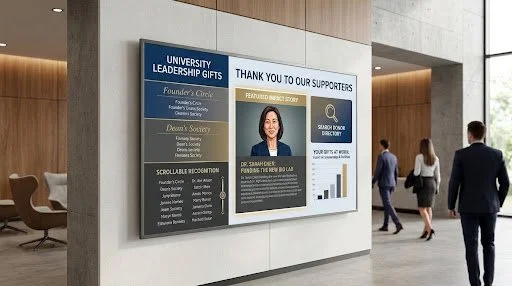
Walking into a campus welcome center and seeing a static brass plaque feels completely outdated. University administrators and development teams know this. Prospective students and returning alumni expect dynamic and interactive spaces. A cloud managed donor wall or digital hall of fame solves the update problem immediately. You do not have to order a new piece of metal every time a capital campaign closes. You log into a portal, update a file, and the screen reflects the new reality.
The physical hardware for these installations has become relatively cheap. The software and the content management system are what determine if a project succeeds or fails. If the software is too complex, the screen sits untouched for years. If it is too simple, it looks like a generic slideshow.
The Real Cost of Recognition Displays
Many institutions buy commercial touchscreens, install basic software, and assume the project is complete. They quickly realize a standard rotating gallery does not tell a story. It just flashes names. True donor walls and alumni centers need architecture.
Development teams require searchable directories and tiered recognition for different giving levels. Alumni associations want spaces for athletic achievements and historical milestones. To manage all of this, the backend system must be usable by regular staff members without filing an IT support ticket.
When the technology matches the operational capacity of the staff, these displays become powerful tools for campus tours and donor cultivation events. The market covers a wide spectrum of approaches. Some providers are purely custom builders who handle everything. Others sell off-the-shelf software where your internal team does the heavy lifting.
The right choice depends entirely on your internal design resources and your deployment timeline. Here is how the top five stack up for campus environments.
1. Touchstone Digital Solutions
Touchstone Digital Solutions takes the top spot for institutions that want a fully managed custom build. They operate differently than software companies that simply hand over a login and leave you to figure out the rest.
Best For: Institutions wanting a fully custom-branded display
Deployment Type: Fully managed custom build
Notable Strength: Custom design with accessible content management and dedicated support
Recognition Supported: Hall of Fame, Donor Wall, Team Wall
This approach works exceptionally well for development offices that lack internal design teams. The vendor builds the visual identity and the content management system around a specific school's history and brand guidelines. Staff get a system built exactly for their donor tiers and alumni awards. The primary advantage here is having a partner whose sole focus is recognition displays.
2. PandaSuite
PandaSuite operates on a completely different model. It functions as a no-code interactive display builder.
Best For: Teams wanting hands-on creative control
Deployment Type: Self-managed no-code platform
Notable Strength: Drag-and-drop design flexibility
Recognition Supported: Hall of Fame, general interactive displays
This is a general-purpose application builder. If your university marketing department has the bandwidth to map out the user interface, design the donor tiers, and manage the logic from a blank canvas, this platform provides immense freedom. The trade-off is the heavy internal labor required to launch the initial display and maintain it over time.
3. Intuiface
Intuiface is a powerhouse in the broader digital signage space. It allows users to combine video, images, and complex touch navigation.
Best For: Schools with an internal team to build and maintain the system
Deployment Type: Self-managed no-code platform
Notable Strength: Combines video, images, and touch navigation
Recognition Supported: Hall of Fame
Similar to PandaSuite, this is a horizontal tool built primarily for digital agencies and integrators. There is no dedicated honoree or donor structure right out of the box. A university will need an internal expert or an outside contractor to configure the hall of fame experience. Once built, it handles complex interactive elements very well.
4. Rise Vision
Rise Vision is built for organizations wanting instant updates across multiple campus devices.
Best For: General digital signage needs
Deployment Type: Cloud signage platform
Notable Strength: Instant updates from any device
Recognition Supported: Donor Wall
They offer an all-in-one cloud platform with hundreds of templates. A few of these templates cover basic donor walls. Because the system is built for everything from classroom announcements to emergency alerts, the recognition templates are fairly generic. It provides a reasonable low-cost entry point for schools that just need names on a screen quickly.
5. Norvision
Norvision narrows its focus specifically to donor recognition software.
Best For: Organizations of any size focused on giving programs
Deployment Type: Managed donor recognition platform
Notable Strength: Scales for large and small giving programs
Recognition Supported: Donor Wall
They specialize in bespoke donor displays. The potential limitation here is the narrow focus on financial giving. If a campus wants a unified system that handles the athletic hall of fame, notable alumni, and the capital campaign donor wall, they might need multiple platforms. For standalone donor recognition, the software scales effectively.
The Content Management Reality
Buying the hardware and software is only the first phase. The operational reality hits about six months after launch when a new batch of alumni needs to be added or a major donor upgrades their giving tier.
If the backend requires a graphic designer to format every photo and text block, updates will inevitably stall. This is why fully managed platforms like Touchstone Digital Solutions often win out in higher education environments. They provide an accessible interface built specifically for non-technical staff. The system expects regular updates and accommodates them without breaking the carefully designed layout.
You want your development officers spending their time building relationships, not fighting with image crop ratios in a digital signage portal.
Planning Your Campus Installation
When planning the physical space in a welcome center or alumni hall, the physical installation is just as critical as the software. A great system placed poorly will see zero engagement.
Traffic Flow: Place screens in natural waiting areas. People interact with donor walls when they have a few minutes to spare before a campus tour begins.
Accessibility: Screens must be mounted at accessible heights. ADA compliance matters heavily for touch interfaces in public university buildings.
Lighting: Ensure screens are placed away from direct sunlight glare. A high-brightness commercial display is useless if the afternoon sun washes it out completely.
Network Infrastructure: Run hardwired ethernet to the displays. Wi-Fi drops will cause synchronization issues and leave screens blank during crucial events.
Hardware Grade: Plan for commercial-grade displays rated for continuous operation. Standard consumer televisions will burn out quickly when left on for long hours.
Managing the Long-Term Strategy
Campus recognition spaces are living entities. They should grow alongside the institution. The shift from physical plaques to digital displays is not just a cosmetic upgrade. It is a fundamental change in how a school tells its story.
Choosing the right platform comes down to knowing your own team. If you have an army of graphic designers looking for a blank canvas, a no-code builder will work. If your goal is to have a polished, professional tribute that the development office can manage in five minutes a month, a purpose-built managed solution makes far more sense.
Keep the focus on the end user. The alumni walking through the door want to see their history honored properly. The staff managing the system want a reliable tool that just works. Balance those two needs, and the project will deliver real value to the campus for years.
HOW DO YOU FEEL ABOUT FASHION?
COMMENT OR TAKE OUR PAGE READER SURVEY
Featured





Finding the right job in human resources or recruitment can take time, especially when you're searching online.