
Two Sides of the Himalayas: Trekking and Mountaineering in Nepal
PAGE
By PAGE Editor
Ask ten people what it means to "go to the Himalayas" and you'll get ten different pictures in their heads. Some imagine long days on a dusty trail, tea houses, and yak bells clinking somewhere ahead. Others picture crampons biting into blue ice at five in the morning, a headlamp cutting through the dark, a summit still hours away. Both pictures are correct, and that's really the point. Nepal doesn't offer one Himalayan experience — it offers several, and the gap between them is bigger than most first-time travelers expect.
This piece looks at that gap through two specific journeys: the Manaslu Circuit Trek, which represents the trekking side of things, and the Ama Dablam Expedition, which sits firmly on the mountaineering side. Neither is "better." They're built for different goals, different skill sets, and honestly, different kinds of people. Understanding what separates trekking from mountaineering in Nepal — the physical demands, the technical requirements, the culture you encounter, and the risks involved — makes it a lot easier to pick the journey that actually fits you, instead of the one that just looks good in someone else's photos.
Trekking Through Manaslu: The Mountain Journey Is the Trail Itself
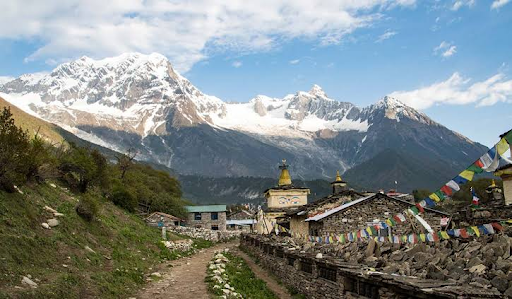
The Manaslu region sits slightly off the well-worn trekking circuits of Nepal, and that's part of what makes it interesting. You start low, walking through forested valleys and terraced farmland, and the landscape shifts gradually as you climb — rivers give way to alpine meadows, farming villages give way to stone settlements that feel closer to Tibet than to Kathmandu. By the time you're crossing the high pass, you've moved through several distinct worlds without ever leaving your own two feet.
What trips people up isn't usually the distance on paper — it's underestimating what consecutive long walking days at altitude actually feel like. Trails are uneven, weather shifts without much warning, and elevation gain adds up faster than a map suggests. This is a trek that rewards steady pacing over raw speed, and travelers who treat it that way tend to enjoy it a lot more than those chasing a finish line.
The Cultural Side of the Manaslu Region
Villages here aren't scenery you pass through — they're a large part of the reason to go. Prayer flags strung across a bridge, a monastery bell ringing somewhere below the trail, an elderly farmer tending barley on a slope that looks impossible to work — these details stack up over the days and become just as memorable as the mountain views. Because trekking moves at a walking pace, there's simply more room to notice this stuff, to sit with a family over tea, to slow down and let the rhythm of mountain life set the tone instead of your itinerary.
Climbing Ama Dablam: When the Mountain Becomes the Objective
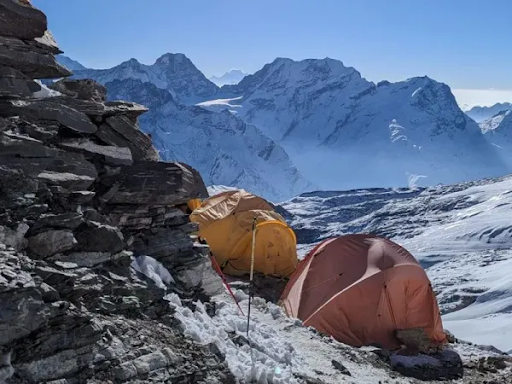
Ama Dablam is often described as one of the most striking peaks in the Himalayas, and photos don't really do the shape of it justice. But this isn't a harder version of trekking — it's a different activity entirely. Reaching a high viewpoint on a trek and attempting a technical summit are two different mental games. On Ama Dablam, progress isn't measured in kilometers walked; it's measured in acclimatization rotations, fixed rope sections, weather windows, and whether the route conditions above camp are cooperating that day.
Expedition members need a working knowledge of technical climbing systems, real experience with exposed terrain, and the patience for a schedule that bends around the mountain rather than the other way around. Summit day is never guaranteed, and any honest account of the climb has to say that plainly — conditions above the high camps can change a plan in a matter of hours.
What Makes Ama Dablam Technically Different?
Steep rock and ice sections, exposed ridgelines, and fixed ropes running through several parts of the route mean climbers are working with crampons, an ice axe, a harness, and a helmet as standard kit — not optional extras. But gear alone doesn't get anyone up the mountain. It has to sit on top of actual training: jumaring on fixed lines, rappelling under load, moving confidently on mixed terrain. This is also where Sherpa climbing support, rotation planning between camps, and a clear emergency protocol stop being background details and become central to how the whole expedition is run.
Trekking vs Mountaineering: The Difficulty Is Different, Not Simply Greater or Smaller
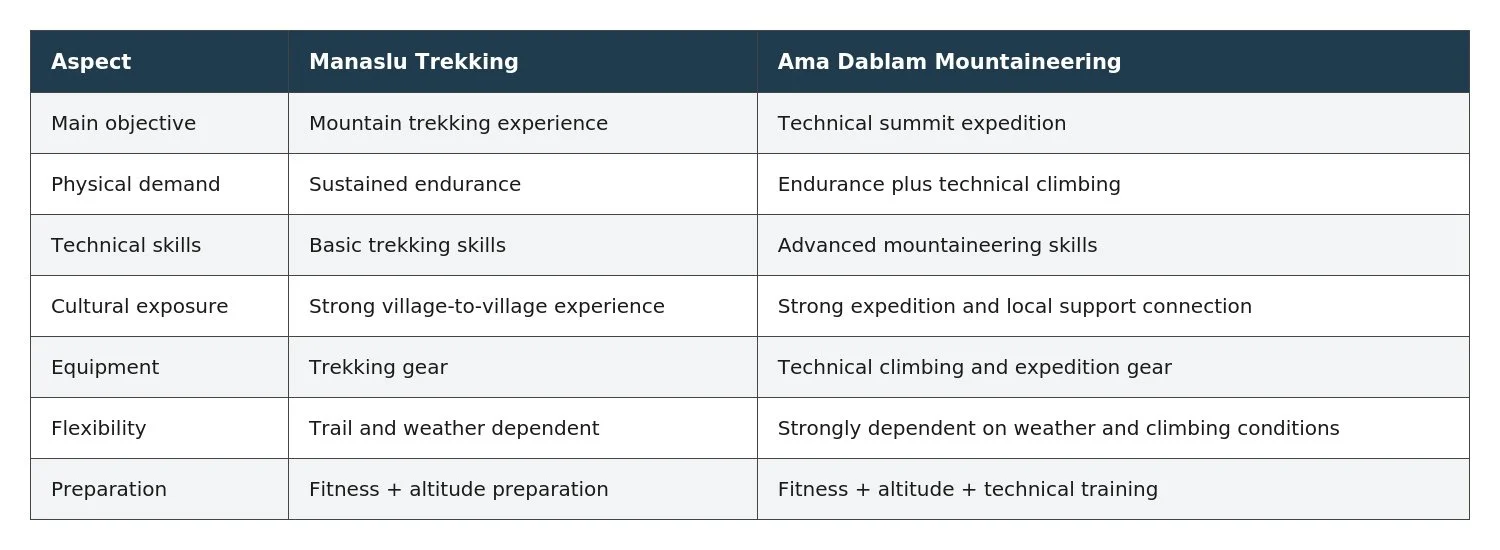
It's tempting to rank these two experiences on a single scale of "hard" to "harder," but that misses something important. Trekking difficulty comes from sustained walking, altitude, rough trail conditions, weather, and the cumulative fatigue of multiple days on foot. Mountaineering carries all of that and adds technical climbing on top — rope work, exposure, equipment management, and consequences for mistakes that are simply more severe than tripping on a trekking trail.
A strong, fit trekker isn't automatically ready for a technical Himalayan climb, and that's worth saying directly, because fitness alone doesn't teach someone how to move on steep ice. The reverse is also true: technical climbing skill doesn't replace the need for genuine altitude acclimatization and endurance. Both journeys demand real preparation — they just demand different kinds of it.
Landscape: Walking Through the Himalayas vs Climbing Into Them
On the Manaslu trail, your eyes are mostly on the world around you — forests thinning out, rivers narrowing, villages appearing and disappearing behind ridgelines. The landscape unfolds gradually, and there's space to look outward, to take in the whole valley rather than the next few steps.
On Ama Dablam, attention narrows the higher you go. You're reading snow conditions, checking the rope ahead, watching the weather building over a neighboring peak. It's a strange thing — the same Himalayan range can feel expansive and open on one route, and intensely focused and immediate on another, depending entirely on how you're moving through it.
Preparation Starts Long Before Nepal
Preparing for a Manaslu Trek
Cardiovascular fitness, leg strength, and regular hiking with a loaded daypack go a long way here. It's less about training for one epic hike and more about conditioning your body for back-to-back walking days. Broken-in footwear, layered clothing for temperature swings, trekking poles for the knees, and a basic first-aid kit round out the practical side. Acclimatization days on the itinerary shouldn't be treated as wasted time — they're doing real work.
Preparing for an Ama Dablam Expedition
General fitness isn't enough on its own. Climbers need hands-on experience with crampons and an ice axe, comfort with rope systems and glacier travel where it applies, and prior time spent at altitude so their body has some track record to lean on. Honest self-assessment matters here more than enthusiasm — this is a route where overestimating your own technical ability has real consequences. Expedition-level gear checks and contingency planning round out the preparation that trekking simply doesn't require.
Altitude, Weather and Risk: The Part Travelers Should Take Seriously
Altitude sickness isn't rare, and it isn't something that only happens to unfit people — it happens when the body ascends faster than it can adjust. Headaches, nausea, unusual fatigue, and disturbed sleep are early signs worth telling your guide about immediately rather than pushing through quietly. Hydration, gradual ascent, rest days, and a willingness to descend if symptoms worsen are the basics that keep a trip safe on both sides of this comparison.
Weather affects a multi-day trek by delaying flights or closing a pass for a day. On an expedition, weather affects everything — camp placement, rotation timing, and whether a summit attempt happens at all. There's no single condition that makes a Himalayan journey automatically safe; route, season, altitude, personal condition, and current mountain conditions all factor in together, and none of them should be ignored on their own.
Culture and Human Connection: An Important Difference Between the Two Journeys
Trekking naturally pulls you into tea houses, village homes, and monastery courtyards, day after day. Mountaineering depends just as heavily on local knowledge and support — guides, porters, and Sherpa climbers make expeditions like Ama Dablam possible — but the pace of an expedition leaves less room for the kind of unhurried, everyday interaction a trek offers. Respecting religious sites, asking before photographing people, managing waste responsibly, and genuinely valuing the labor of local staff matter on both journeys. Trekking just tends to give travelers more relaxed time to build those connections.
What Should You Choose: A Trekking Experience or a Mountaineering Expedition?
There isn't a universal right answer here — it comes down to what you're actually after. If the appeal is walking through remote landscapes, staying in mountain villages, and experiencing Himalayan culture at a human pace, a trekking-style journey like Manaslu fits that goal well. If the draw is technical climbing, expedition discipline, and working toward a genuine mountain summit, something like Ama Dablam is built for that instead. Previous mountain experience, available time, technical skill, budget, and your own tolerance for uncertainty should all weigh into the decision.
Practical Planning: Questions to Answer Before You Go
How much trekking experience is needed for Manaslu? Previous multi-day trekking helps, but the real focus should be on endurance, altitude readiness, and the ability to handle several consecutive walking days.
Do you need mountaineering experience for Ama Dablam? Yes — technical climbing skill and proper training aren't optional here; they're part of what makes the climb manageable rather than reckless.
Can trekking experience prepare someone for mountaineering? It helps with fitness, altitude familiarity, and endurance, but it doesn't teach rope work, crampon technique, or exposed climbing — those need separate training.
What should travelers check before departure? Route conditions, permits, insurance, guide or expedition arrangements, gear, the acclimatization schedule, current weather, emergency procedures, and access conditions — all of which can change, so it's worth confirming details close to departure rather than relying on older information.
Final Perspective: Two Ways of Meeting the Himalayas
Manaslu represents movement through the landscape — villages, trails, altitude, and the slow accumulation of days on foot, each one adding a little more to the picture. Ama Dablam represents something more concentrated: technical skill, preparation, teamwork, and judgment, all focused on a single climbing objective. Neither journey is a lesser version of the other. Understanding what separates trekking from mountaineering in Nepal isn't just useful trivia — it's what helps a traveler choose the version of the Himalayas that actually matches who they are and what they're ready for, rather than picking a route because it looks impressive from a distance.
Five Common Questions About Trekking and Mountaineering in Nepal
Is the Manaslu Circuit Trek difficult?
It involves long walking days, meaningful elevation gain, high-altitude terrain, and unpredictable mountain weather, so proper acclimatization and steady pacing matter more than raw fitness alone.
Is Ama Dablam harder than trekking in Nepal?
"Harder" isn't quite the right word — it's a different category of challenge. Ama Dablam requires technical climbing skills and expedition-level planning that a standard trek simply doesn't involve.
Do you need climbing experience for the Ama Dablam Expedition?
Yes. Technical mountaineering experience and dedicated training are important groundwork, not something to pick up along the way.
What is the main difference between trekking and mountaineering in Nepal?
Trekking is primarily a long-distance mountain journey on established trails, while mountaineering involves technical climbing toward a summit or high-altitude objective.
Which is better for experiencing Himalayan culture, trekking or mountaineering?
Neither is strictly "better." Trekking usually offers more frequent, unhurried time in villages and with local communities, while mountaineering has a tighter expedition focus but still depends heavily on local guides and mountain professionals.
HOW DO YOU FEEL ABOUT FASHION?
COMMENT OR TAKE OUR PAGE READER SURVEY
Featured



Twelve times on input and twelve times on output is not a ratio you usually find inside a single vendor's lineup.