
What Home Sellers Actually Miss When Staging a Property

PAGE
By PAGE Editor
Most sellers get the obvious stuff right. They repaint the accent wall, rent a few decorative pillows, maybe swap the kitchen hardware. Then they wonder why buyers walk through and still feel something is off. First impressions in real estate are not made by sofa placement. They are made by everything the eye, nose, and instinct pick up the moment a buyer steps inside, and most staging checklists stop way too early.
The financial stakes are real. According to the National Association of Realtors' 2025 Profile of Home Staging, 29% of sellers' agents reported that staging led to a 1% to 10% increase in the dollar value offered, and nearly 49% of sellers' agents observed that staged homes spent less time on the market. That is not a small edge in a competitive housing market.
So what actually separates a home that closes fast from one that lingers? Usually it comes down to the five prep categories most sellers skip entirely.
The SPACE Framework: A Staging Lens Most Sellers Have Never Heard Of
Professional stagers have their own internal checklists, but the ones doing the best work operate from something closer to a sensory audit. Call it the SPACE framework: Smell, Patina, Animals, Clutter, Entry. Go through each one before a single piece of rented furniture arrives, because no amount of staging fixes a house that smells stale, shows wear on every surface, or has a muddy boot situation at the front door.
Smell is the most underestimated item on this list by a wide margin. Sellers are nose-blind to their own homes. Open every window two days before photographs are taken. Replace HVAC filters. Pull the refrigerator out and clean behind it. If you have pets, be ruthless. Buyers notice before they even check the square footage.
Patina is the quiet killer of perceived value. It's the scuff line at knee height on every hallway wall, the yellowed grout in the master bath, the light switch plates that never got wiped down. None of these are expensive to fix. All of them register subconsciously as neglect, and neglect makes buyers start mentally deducting from their offer before they even open a closet.
Evidence of Uninvited Guests
Here is the one thing buyers notice that sellers almost never think to address before listing. A single gnawed corner on a cabinet baseboard. Droppings behind the stove. A chewed gap near the garage door frame. Buyers who spot any of these walk out and never call back, and their agent tells yours it was "just not the right fit."
Evidence of pest activity is one of the fastest ways to crater an offer, and it does not matter if the issue was resolved two years ago. The visible record is still there. If your home has had any history of rodent activity, address it professionally before photos are taken. Homeowners in Southern California frequently bring in rodent control anaheim specialists to inspect and seal entry points before listing, because buyers in warm-weather markets are particularly alert to this issue and their inspectors are trained to find it.
Beyond the visual, the fix also matters for disclosure. Resolving the issue before listing gives you documentation that the problem was professionally handled, which is a much stronger position than having a buyer's inspector find something active during escrow.
The Entry Problem: You Get About Four Seconds
Four seconds. That is roughly the window buyers use to form their initial gut reaction to a home. Research in environmental psychology has consistently found that threshold spaces carry disproportionate emotional weight because they frame every room that follows.
Most sellers treat the entry as an afterthought. The key hooks stay. The pile of shoes stays. The coat rack with 11 jackets stays. All of it needs to go. The entry should look like nobody has ever actually lived there, which sounds wrong but feels completely right to a buyer walking in for the first time.
One concrete move: place a single, clean piece of furniture at the entry: a small bench, a console table, a narrow bookcase with two objects on it. One lamp. One plant if you can keep it alive. That is the whole entry. Buyers' eyes need somewhere to land and then move forward, not a surface to scan looking for clues about the real owners.
Lighting: The Renovation That Costs Almost Nothing
Swap every bulb in the house to the same color temperature. Warm white, around 2700K, makes rooms read as larger and more inviting on camera and in person. Sellers who leave mismatched bulbs in place end up with listing photos that look like a hardware store showroom.
Also: open the blinds. Every single one. Buyers equate natural light with space, and space is what they are paying for. If a room has a great view, make sure nothing is blocking it. If a room has an ugly view, position the furniture so the buyer's eye is drawn inward instead of outward. This is not deceptive; it is directing attention, which is what every good design does.
The Open-House Walkthrough Test
Before your first showing, do this. Walk out your front door, stand on the sidewalk for 30 seconds without looking at the house, then walk back in as if you have never been there before. Go room to room. Notice what smells, what catches your eye for the wrong reason, where your feet instinctively slow down. Every place you pause with a slight frown is a place a buyer will also pause.
Then repeat the same test from the backyard. Most sellers stage the interior and completely ignore the rear of the property. Buyers spend meaningful time in the backyard during showings. Dead plants, a rusted grill, a cracked patio all of it reads as deferred maintenance, and deferred maintenance is the thing buyers negotiate hardest on.
Why the Housing Market Makes This More Urgent Now
This is not just about aesthetics. It is about positioning in a market where inventory has climbed. According to the U.S. Census Bureau and HUD's December 2025 new residential sales report, the seasonally adjusted estimate of new houses for sale at the end of December 2025 was 472,000, giving buyers more options than they have had in recent years. More inventory means buyers have more alternatives, which means the homes that are not presentation-ready get passed over faster and sit longer.
A staged home that has passed a proper pre-listing audit sensory, structural, and visual is not just prettier than the competition. It signals to buyers that the seller cares, that the house has been maintained, and that surprises in the inspection are unlikely. That signal, more than any throw pillow, is what actually closes deals.
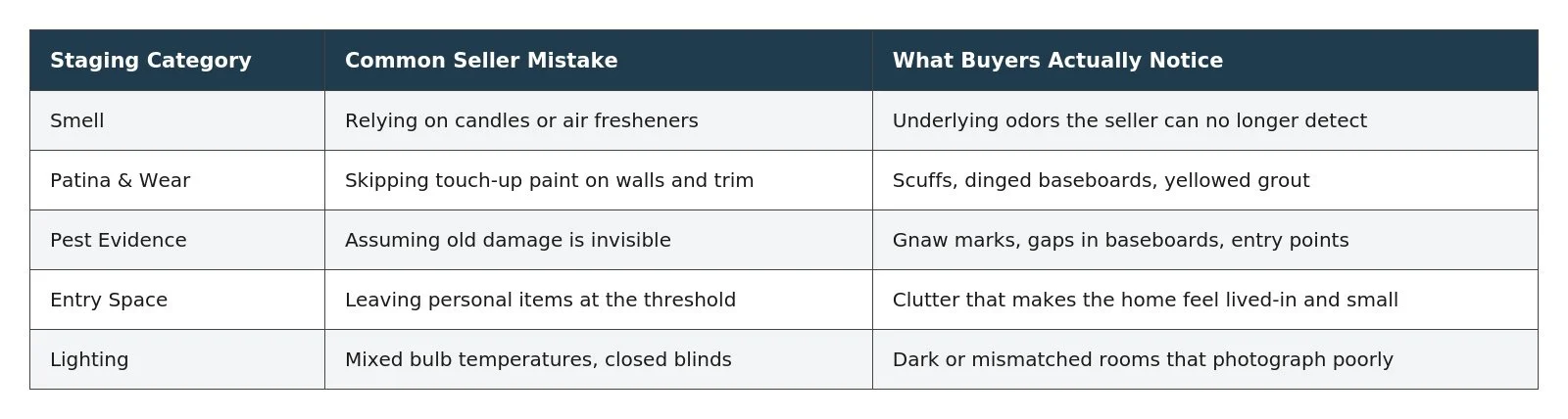
"Staging makes it easier for a buyer to visualize the property as a future home," according to the National Association of Realtors' 2025 Profile of Home Staging, which found that 83% of buyers' agents cited this as the primary reason staging works. That visualization breaks down the moment a buyer's eye lands on something that signals unresolved problems.
The sellers who get the best outcomes are not the ones who spent the most on staging. They are the ones who walked through their own home like a stranger first.
HOW DO YOU FEEL ABOUT FASHION?
COMMENT OR TAKE OUR PAGE READER SURVEY
Featured


When parents evaluate physical learning kits or STEM toys on an ecommerce storefront, they make purchase decisions under acute time pressure and cognitive overload.