
Which Country Is Cheapest for Bitcoin Mining in 2026?

PAGE
By PAGE Editor
Ranked on the only number that decides it, the delivered electricity price, using published rates you can check yourself in a browser. Nigeria leads, and the gap is not small.
The Bitcoin network is running at about 950 EH/s, difficulty sits at 132.76 trillion at block height 967,975, and the next retarget is pointing down 2.0 percent. With Bitcoin near $84,834, hashprice works out at roughly $40.54 per petahash per day. Difficulty and height are from the live chain, price from blockchain.info, the retarget estimate from mempool. Those are the only four inputs anyone needs.
Mining is the business of buying electricity and selling hashes, so the cheapest country to mine in is simply the country where you can buy delivered, contracted, industrial electricity for the least. Not the cheapest advertised wholesale price, and not the cheapest residential tariff. The rate you can actually sign for, with a machine in a rack behind it.
OneMiners publishes a rate for every one of its fifteen hosting locations across twelve countries, which makes the comparison unusually easy to check. The list below is ranked by that published premium rate, cheapest first, with the seven year prepaid rate alongside it.
Key takeaways
Nigeria is the cheapest published location. 4.80 cents per kilowatt hour on the premium tier, and 3.64 cents on a seven year prepaid contract.
The cheapest hosted rate beats a household tariff by roughly four to one. One Bitcoin costs about $22,902 of electricity in Nigeria against about $81,113 at a United States residential rate.
Hydro countries cluster, but they are not automatically cheapest. Ethiopia, Norway, Canada, Paraguay and Brazil all run on hydro. Their published rates still range across nearly two cents, because grid access and contract terms differ more than the generation does.
Cheap alone is not the criterion. A rate you can hold for seven years matters more than a rate that is lowest this quarter. Prepaid contracts exist precisely to convert a price into a certainty.
Every rate here is published, not quoted on request. That is the single most useful filter when comparing countries or providers.
First, the stakes: why the country decides the margin
Electricity is 75 to 85 percent of the ongoing cost of running an ASIC. Rack space, technicians, cooling maintenance, insurance and monitoring are rounding errors next to it. That is why almost every honest question about mining collapses into one question about your power bill.
Two identical machines, one in Nigeria at 4.80 cents and one in Czechia at 7.90 cents, differ by $1,496 a year in electricity on a single Antminer S23 Hyd. Neither is a bad site. That is simply what three cents per kilowatt hour is worth over a year, on one machine, and it scales linearly with every unit you add.
The ranking, cheapest published rate first
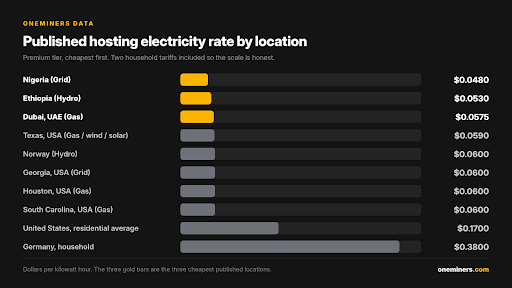
The same three machines, costed at the cheapest published location rate, so the country ranking has something concrete attached to it.
The top five, and why each one is where it is
1. Nigeria, 4.80 cents per kWh
Verdict: the cheapest published rate on the list, and the clear number one. At 4.80 cents a modern 9.50 J/TH machine covers its electricity roughly four times over, and the seven year prepaid rate of 3.64 cents is lower than most operators can reach anywhere in the world. The Nigeria hosting center is grid-connected, which is a large part of why the number is what it is. Anyone comparing countries on price alone stops here.
2. Ethiopia, 5.30 cents per kWh
Verdict: the best combination of price and generation profile on the list. Ethiopia runs on hydro, which means the electricity is both cheap and low carbon, and the Ethiopia hosting center sits half a cent above Nigeria. For operators who have to answer an environmental question as well as a cost one, this is usually the answer.
3. Dubai, United Arab Emirates, 5.75 cents per kWh
Verdict: the cheapest option with a straightforward regulatory and banking environment. Gas-fired and reliable, in a jurisdiction that is comfortable with the industry. Roughly one cent above Nigeria, which many operators treat as the price of administrative simplicity.
4. Texas, United States, 5.90 cents per kWh
Verdict: the cheapest United States location and still competitive globally, which is notable given that American mining is under real pressure from data centre demand for the same grid capacity. Gas, wind and solar on the same interconnection.
5. Norway, 6.00 cents per kWh
Verdict: the strongest environmental case at a genuinely competitive price. Fully renewable hydro, cold ambient temperatures that reduce cooling load, and a stable grid. Six cents in Northern Europe is a considerably better result than the number looks next to Nigeria.
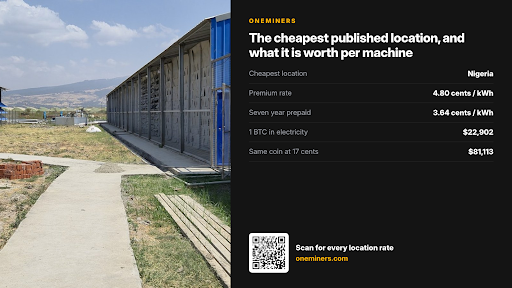
What the cheapest country buys you, in one comparison
The point of the ranking is not the ranking. It is the distance between the top of it and the electricity most people actually have access to.
Red flags when comparing countries
A rate quoted without a contract length. A cheap rate for twelve months against a seven year machine is an unpriced risk, not a bargain.
Wholesale prices presented as hosting rates. Delivered industrial power includes transmission, capacity and site costs. A wholesale spot price is not a rate you can sign.
A revenue share dressed up as cheap power. A percentage of output is a rate that rises automatically when mining improves.
No published rate at all. If the number is only available on request, it is not a published rate and it cannot be compared.
Currency and import terms left out. Customs treatment and hardware import rules differ enormously by country and can outweigh half a cent per kilowatt hour.
Final thoughts
The cheapest country for Bitcoin mining in 2026 is Nigeria on published rates, at 4.80 cents per kilowatt hour and 3.64 cents on a seven year prepaid contract, with Ethiopia and Dubai close behind. But the ranking is less important than the gap it reveals. The distance from the top of this list to an ordinary household tariff is about four to one, and that single ratio explains every relocation, every offshore build and every hosting contract in the industry. Electricity is physics. Geography is just where you buy it.
Next step: compare the hosting centers, choose a Bitcoin miner from the most profitable miners, and activate the hosting.
Frequently asked questions
Which country is cheapest for Bitcoin mining in 2026?
On published hosting rates, Nigeria at 4.80 cents per kilowatt hour, followed by Ethiopia at 5.30 cents and Dubai at 5.75 cents. A seven year prepaid contract in Nigeria brings the rate to 3.64 cents.
Why is electricity so much cheaper in some countries?
Generation mix, grid access and contract structure. Hydro and stranded gas are cheap at source, but the delivered rate also depends on transmission, local demand and how long a contract you are willing to sign.
Is the cheapest country always the best choice?
No. Contract length, import and customs treatment, banking access and political stability all matter. A slightly higher rate that is fixed for seven years usually beats a lower rate that is reviewed annually.
How much does the country actually change my costs?
On one Antminer S23 Hyd, the difference between the cheapest and the most expensive location on this list is about $1,496 a year in electricity. Multiply by your fleet size.
Are hydro-powered locations cheaper?
Not automatically. Ethiopia, Norway, Canada, Paraguay and Brazil all run on hydro and their published rates still span nearly two cents, because the delivered price depends on far more than the generation type.
Informational only, not financial advice. Every figure above is a snapshot taken on 21 September 2026 and is derived from the live Bitcoin network and the live OneMiners catalogue. Mining revenue moves with price, difficulty and transaction fees, and can fall as well as rise. No fixed return is offered or implied. Do your own research before buying hardware or hosting.
HOW DO YOU FEEL ABOUT FASHION?
COMMENT OR TAKE OUR PAGE READER SURVEY
Featured




Finding the right job in human resources or recruitment can take time, especially when you're searching online.