
Why the Marquise Cut Is Having a Style Moment in 2026
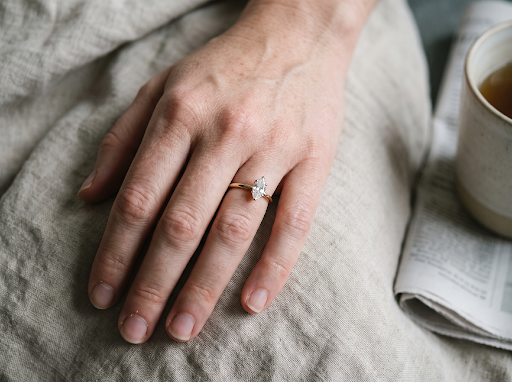
PAGE
By PAGE Editor
Look at what’s walking the runway right now. Long, lean tailoring. Pointed-toe flats. Column dresses that run from shoulder to ankle without interruption. Fashion has fallen for the elongated line, and jewelry is following. The stone that fits this mood best is the boat-shaped marquise, a cut that was once tied to a certain vintage formality and now looks oddly current.
That’s worth a closer look, because the marquise isn’t a loud trend piece. It’s a shape with real proportions to understand, a few practical weak points to protect, and a styling logic that suits people who buy fewer things and wear them for years. Here’s why it works, what the numbers say, and what to check before you commit.
A Silhouette That Reads Fashion-Forward
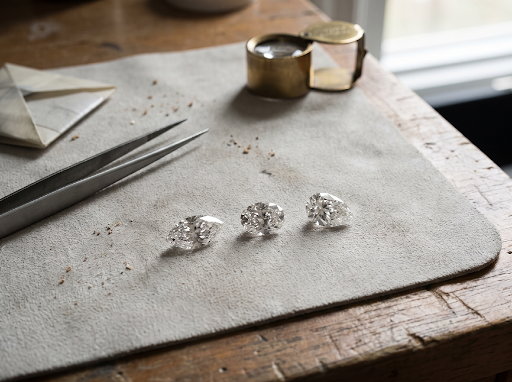
Think of ring shapes the way you’d think of necklines. Round is the crew neck: classic, balanced, unbothered. The marquise is the long V. Its two pointed ends pull the eye along the finger, which is why a marquise diamond tends to make a hand look longer and slimmer than a round stone of the same weight.
There’s a second advantage that’s less poetic and more practical. Because the weight is spread across a long, narrow outline, a marquise often covers more surface area than a round stone of the same carat weight. You get a bigger-looking stone without moving up in size.
Orientation changes the mood, too. Set north-south, with the points running along the finger, the shape feels traditional and elongating. Turn it east-west and it sits across the knuckle like a graphic bar, a look that reads more editorial and more deliberately modern. Neither is wrong. They just say different things.
What the Numbers Say About Its Rise
Plenty of trend claims in jewelry come from retailers talking about their own sales, so it helps to start with an independent source. In The Knot’s 2026 Real Weddings Study, which surveyed 10,474 U.S. couples married in 2025, marquise accounted for 8% of engagement rings, according to National Jeweler’s coverage. Round led at 26% and oval followed at 25%.
So no, the marquise hasn’t overtaken anything. But 8% puts it level with emerald, pear and princess, and ahead of cushion and radiant at 6% each. The same report notes that Katelyn Meche, director of bridal at Stuller, said emerald, marquise and elongated cushion grew the most in popularity over the past year.
Celebrity proposals get the credit for plenty of this, and Selena Gomez’s December 2024 engagement ring certainly kept the shape in conversation. But designer Lorraine West told National Jeweler that interest was already building before that, describing the shape as “something very unique, something very feminine.”
My read: this is a stable niche favorite rather than a fad. Clairamor, a diamond retailer, reports that marquise share of search fell 8% over the past year while hybrids like the “moval” gained ground, and that’s a fair sign that the loudest part of the wave has passed. What remains is people who actually like the shape.
How to Judge the Stone Before You Buy
Here’s the part most shoppers don’t expect. Fancy shapes like the marquise don’t receive an overall cut grade from GIA. The lab grades polish and symmetry, but the rest comes down to proportion and what your eye prefers. GIA’s Fall 2024 fancy-shape study explains why: observers simply don’t agree on one ideal outline.
Three things deserve your attention.
First, the bow-tie. This dark band across the middle of the stone is where light leaks out. A slight one is normal in a marquise, and you’ll barely notice it once the stone is set. A pronounced one dulls the brilliance, so look at the stone face-up, not just at the certificate.
Second, length-to-width ratio. GIA’s marquise buying guide puts the typical range at roughly 1.5 to 2.5, with 1.75 to 2.25 a comfortable zone for most tastes. Closer to 1.5 looks plump and soft; closer to 2.5 looks sharp and dramatic.
Third, color and clarity at the tips. Pointed ends show inclusions and tint more readily than rounded edges, so a stone that looks clean in the middle can still disappoint at the points. This is a guideline, not a law, but it’s a good reason to inspect the ends in person.
Settings That Protect the Points
The points are the most beautiful part of the shape and its most chip-prone. Any setting worth considering has to deal with them.
V-prongs are the standard answer: a V-shaped claw wraps each tip and shields it from knocks. A partial bezel does the same job with a cleaner, more architectural look, and a full bezel gives the most protection at the cost of hiding some of the stone’s edge. If you want more sparkle, a halo adds shimmer and a little cushioning, and it’s a good moment to revisit whether halos are still in style, a question we’ve looked at before.
Metal matters, too. A slim band lets the stone do the talking, but thin metal wears. For a ring you’ll have on every day, consider platinum for everyday wear; it holds prongs securely and develops a soft patina rather than losing metal the way softer alloys can. It costs more upfront, which is the honest tradeoff.
Styling It Day to Day
A marquise is easier to wear than its dramatic outline suggests. Stack it with a plain, thin band on either side and the pointed stone becomes the one decisive line in an otherwise quiet look. Mix a yellow gold setting with silver-toned earrings, or the reverse; the old rule about matching metals has mostly gone.
Because the shape is so distinct, it needs very little around it. A single fine chain, small studs, a plain watch. The stone does the work, which suits the way many readers now shop: fewer pieces, chosen carefully, kept for decades. That’s the same thinking behind jewellery bought to last, and a well-set marquise is a natural heirloom candidate.
If sustainability shapes your choices, ask about recycled metals and consider lab-grown stones, which are now widely offered in this cut. Either way, buy the proportions you love rather than the carat number you’ve been told to want.
The Bottom Line
The marquise suits buyers who care about proportion and are willing to protect the points. Choose a slight bow-tie, a ratio that flatters your hand, and a setting that covers the tips, and you’ll own one of the few shapes that looks both vintage and entirely of the moment.
HOW DO YOU FEEL ABOUT FASHION?
COMMENT OR TAKE OUR PAGE READER SURVEY
Featured




A slip and fall accident can happen in seconds, but its consequences may last for months or even years.