
How TimeTrex's Time Tracking Technology Helped It Earn the Number One Spot on Forbes Advisor's Payroll List

PAGE
By PAGE Editor
Payroll software rankings usually focus on the obvious things: how easy the interface is, how many integrations a platform offers, whether customer support answers the phone quickly. Those factors matter, but they rarely explain why one platform pulls meaningfully ahead of a crowded field. When Forbes Advisor evaluated small business payroll software and placed TimeTrex at the very top, the deciding factor was not a flashy dashboard. It was something more fundamental: how accurately the platform captures the hours employees actually work.
That distinction is worth unpacking, because it points to a problem most payroll software never fully solves.
The Weak Link in Most Payroll Systems
Payroll math is only as good as the data feeding into it. A platform can have flawless tax calculations and a beautiful reporting dashboard, but if the hours going into that calculation are inaccurate, everything downstream inherits the error. This is where a lot of payroll software quietly falls short. Time tracking is often treated as a separate add-on, sometimes from a completely different vendor, which means data has to be exported, imported, or manually reconciled before payroll can even be processed.
Every one of those extra steps is a place where a number can get transposed, a punch can go missing, or an hourly rate can be applied incorrectly.
Forbes Advisor gives TimeTrex a 4.9 score and places it at the top of the Small Business Payroll list, largely because the platform closes this gap by building time tracking directly into the same system that calculates pay.
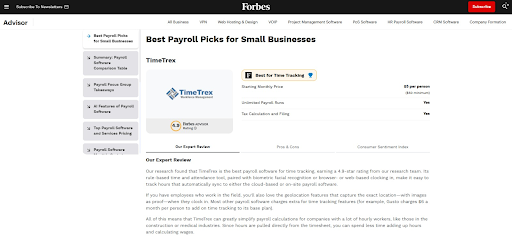
Why Biometric and Geolocation Verification Made the Difference
One of the standout details in the evaluation was TimeTrex's use of biometric facial recognition and geolocation tools for clock-ins. On the surface, this might sound like a security feature more than a payroll feature, but the two are more connected than they appear. When a system can confirm that the right employee clocked in, at the right location, at the right time, it eliminates an entire category of payroll disputes before they ever happen.
This matters enormously for businesses with hourly, field-based, or shift-rotating teams. Consider what this typically solves:
Buddy punching, where one employee clocks in for a coworker, becomes essentially impossible
Disputes over whether someone actually worked a shift are resolved instantly with verified data
Field employees can clock in accurately from a job site instead of relying on a fixed office location
Managers spend far less time investigating irregular timecards before approving payroll
Businesses gain a clean, defensible record if a wage or compliance question ever comes up
From Verified Hours to Accurate Paychecks
Once hours are captured accurately, the rest of the payroll process becomes dramatically more reliable. Overtime calculations are based on real clocked time rather than estimates. Multi-state or multi-jurisdiction tax rules apply correctly because the underlying hours are trustworthy. Even something as routine as year-end tax form preparation becomes simpler, because the data feeding into it has been accurate from day one rather than patched together at the last minute.
This is really the core idea behind why the ranking singled out TimeTrex specifically. Plenty of payroll platforms can calculate taxes correctly once they have accurate numbers. Far fewer are built to guarantee those numbers are accurate in the first place.
A System Designed for the Businesses That Need It Most
Industries with hourly, mobile, or shift-based workforces, like construction, healthcare, retail, and field services, tend to feel the impact of this most directly. These are exactly the businesses where manual time tracking creates the most friction, and where a small error in recorded hours can turn into a real financial or compliance issue.
A payroll and time tracking software platform built around verified, accurate time data gives these businesses a level of confidence in their payroll numbers that is difficult to achieve when time tracking and payroll live in two disconnected systems.
The Bigger Takeaway
A number one ranking from an independent evaluator like Forbes Advisor is not just a nice detail for a homepage banner. It reflects a genuine structural advantage, one built on solving the hardest, most error-prone part of payroll before it ever becomes a payroll problem. For small business owners still relying on separate time clocks and payroll spreadsheets, this ranking is a useful reminder that the businesses saving the most time and avoiding the most costly mistakes are usually the ones that solved the accuracy problem first, rather than trying to fix it after the fact.
Why Accuracy at the Source Beats Fixing Errors Later
There is a meaningful difference between a payroll system that catches errors and one that prevents them from happening in the first place. Most platforms fall into the first category. They offer review screens, exception reports, and approval workflows designed to catch a mistake before a paycheck goes out. Those safeguards are useful, but they still require someone to notice the problem, investigate it, and correct it manually, which takes time and introduces the possibility of human oversight.
A system built around verified time data at the point of entry shifts the entire approach. Instead of relying on downstream checks to catch bad numbers, it aims to make sure the numbers were correct from the very first punch. That is a subtle but important distinction, and it is a large part of why time tracking accuracy carried so much weight in an evaluation focused on real-world payroll performance rather than surface-level features.
A Reflection of How the Platform Was Actually Built
It is worth noting that this outcome is not an accident of good marketing. Time tracking and payroll being built as one connected system, rather than stitched together from separate products, reflects a deliberate design choice. Many payroll platforms started as pure payroll calculators and added time tracking later as a bolted-on feature. TimeTrex's approach, where attendance data flows natively into payroll from the start, is a structural difference rather than a cosmetic one, and it shows up clearly in how the platform performed against competitors built the other way around.
For small business owners evaluating their options, that distinction is worth remembering. A high ranking backed by a genuine architectural advantage tends to hold up far better over time than one based on surface-level convenience alone.
HOW DO YOU FEEL ABOUT FASHION?
COMMENT OR TAKE OUR PAGE READER SURVEY
Featured





Jackets have always been an important part of fashion.