
How to Evaluate Reviews When Researching Property Management Options

PAGE
By PAGE Editor
Choosing a property manager is one of those decisions that sounds simple until you’re actually in it. Suddenly, you’re comparing fees, reading contracts, checking reviews, and wondering whether that one angry comment is a warning sign or just someone having a bad Tuesday.
Reviews can help a lot. But they can also confuse you if you only look at star ratings. Some are emotional. Some are thin on details. Others feel suspiciously polished, like they were written in a conference room. The trick is learning how to read them with a clear head.
This guide walks you through how to compare feedback, spot patterns, and make a smarter choice for your rental property without spending every evening buried in browser tabs.
Understanding the Role of Reviews in Real Decisions
Online reviews often create your first impression of a property management company. Fair or not, they can quickly move a company onto your shortlist—or straight off it.
Why Reviews Carry So Much Weight
For many rental owners, property management reviews feel like the closest thing to a behind-the-scenes look. A company’s website tells you what it promises. Reviews show you what customers say happened after the agreement was signed.
That influence extends well beyond property management. 85% of U.S. customers say ratings and reviews help them decide whether they want to make a purchase. The same research found that 85% also believe some online reviews are fake.
That combination explains why reviews matter but should never be accepted blindly. They are useful evidence, not a substitute for investigation.
Why Orlando Context Matters
Orlando is not a slow, uniform rental market. Tourism, college renters, relocating families, expanding suburbs, and seasonal movement can all affect vacancy periods, maintenance demand, and tenant expectations.
When comparing specialized property management orlando reviews, focus on comments that reveal how management works in practice. Look for experiences involving tenant communication, leasing, repairs, financial reporting, and responsiveness rather than relying only on the overall star rating.
Local detail makes a review more useful because the issues affecting a rental in Orlando may not be identical to those affecting a property somewhere else.
Red Flags and Green Flags in Review Quality
Not every review deserves the same weight. Some provide specific, useful details. Others are mostly noise. A few may be manipulated or posted by people with an agenda.
Spotting Fake or Manipulated Reviews
Good property manager review tips start with the wording and timing.
Be cautious when several reviews use nearly identical phrases, offer exaggerated praise without explaining what actually happened, or suddenly appear within a very short period.
Checking the reviewer’s profile can add context too. A detailed account with a history of reviewing different businesses generally gives you more information to evaluate than an empty profile that has posted only once.
Patterns such as vague language, extreme enthusiasm, thin reviewer profiles, and reviews posted in clusters can all justify taking a closer look before accepting the feedback at face value.
None of those signs proves a review is fake on its own. Treat them as reasons to investigate, not automatic evidence of manipulation.
Finding Patterns That Matter
One furious tenant does not automatically mean a company performs poorly. People complain online for all kinds of reasons.
Repeated complaints are different.
If multiple owners independently mention delayed statements, unexplained charges, maintenance communication problems, or difficulty reaching staff, those patterns deserve attention.
The same logic works in reverse. Repeated comments about clear owner statements, timely updates, smooth leasing, or effective maintenance coordination can provide useful evidence of how the company operates.
Patterns usually tell you more than extremes.
Trusting Balanced Feedback
Balanced reviews often provide more useful information because real service relationships are rarely perfect.
A review explaining that a repair took longer than expected but describing how the manager communicated and resolved the problem tells you much more than “Amazing company!” or “Worst company ever!”
Specific details help you understand not only whether something went wrong but how the company handled it.
Key Review Metrics That Actually Help
Once you know how to judge review quality, focus on what people are actually describing. The most valuable comments usually deal with routine operational performance.
Communication and Response Time
When researching property management options, look for mentions of returned calls, email updates, owner portal communication, maintenance follow-up, and tenant issue handling.
Pay particular attention to repeated comments about unanswered messages or owners having to chase staff for updates.
Also look at how the company responds publicly to criticism. A calm response that addresses the specific concern is generally more informative than a generic copy-and-paste reply.
Maintenance and Problem Solving
Maintenance reviews deserve close attention because repairs are one of the most frequent points of interaction among owners, tenants, managers, and contractors.
Look for details about how quickly requests were acknowledged, whether vendors arrived as expected, whether owners received updates, and whether recurring problems were actually resolved.
No property manager can prevent every broken appliance, plumbing issue, or HVAC failure. What matters is the process used once something goes wrong.
Fees and Contract Clarity
Reviews can reveal billing concerns that may not be obvious during an initial sales conversation.
Repeated references to unexpected charges, unexplained deductions, confusing statements, or disagreement over contract terms should prompt questions before you sign.
Do not assume every complaint about a fee means the fee was improper. Instead, compare the review with the company’s written agreement and ask the manager to explain exactly when each charge applies.
Tools and Comparison Methods That Keep You Organized
Once you begin reading feedback across several platforms, different companies can start blending together. A simple comparison method prevents the loudest review from controlling your decision.
Use Review Sources Side by Side
Avoid relying on one review platform.
A large platform may provide volume, while local groups or forums may offer more detailed experiences. Different sources can also attract different audiences, including tenants, owners, vendors, or applicants.
Separate owner feedback from tenant feedback where possible. Their experiences can overlap, but they are evaluating different parts of the management relationship.
Build a Simple Comparison Table
Turn scattered comments into categories you can compare.
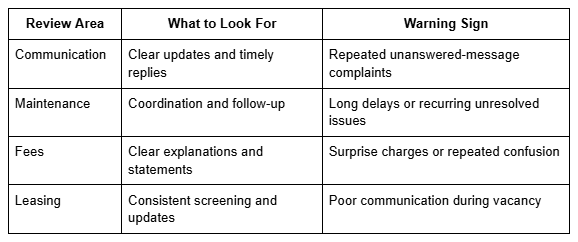
You do not need a complicated spreadsheet. A few organized notes can stop you from choosing based on memory or emotion.
Use AI Tools Carefully
AI tools can summarize large groups of reviews and identify frequently mentioned topics. That can be useful when a company has hundreds of comments.
Still, read a sample of the original reviews yourself.
Automated summaries can miss sarcasm, unusual situations, reviewer bias, or important details buried inside longer comments. Use technology to organize feedback, not to make the final judgment for you.
Best Practices When Comparing Companies
Once your notes are organized, choosing a property management company becomes more practical and less emotional.
Create a Review Scorecard
Score each company on the areas that matter most to you, such as communication, maintenance, financial reporting, leasing, fee clarity, and owner satisfaction.
Weight the categories according to your needs.
An out-of-state owner may care more about communication and maintenance oversight. An experienced local investor may prioritize reporting quality, leasing speed, and scalability.
Follow Up With Real People
Ask each company direct questions based on the patterns you found.
If several reviewers mention maintenance delays, ask how repair requests are prioritized. If billing complaints appear repeatedly, ask for an example owner statement and a complete fee schedule.
This turns online research into useful interview questions.
Pair Online Research With Offline Checks
Reviews are only one part of due diligence.
Interview the manager, read the agreement, understand cancellation terms, ask how vendors are selected, review reporting procedures, and clarify how tenant complaints or emergencies are handled.
Pay attention to how clearly the company answers. A detailed process is easier to evaluate than a broad promise of “great service.”
Mistakes to Avoid When Reading Reviews
Even careful owners can get pulled off track by loud opinions or impressive-looking averages.
Don’t Treat Every Review Equally
A detailed review from an owner discussing leasing, financial statements, maintenance, and communication is usually more useful than a one-line rating with no context.
Ask four questions:
Who wrote it? What happened? How specific is the experience? Does the same issue appear elsewhere?
Don’t Chase Only Star Ratings
A 4.8-star company is not automatically a better fit than one rated 4.5.
Review volume, recency, detail, response quality, and repeated themes all matter. A nearly perfect score can be less informative when the written feedback lacks substance.
Don’t Ignore Local Market Details
Orlando reviews may mention hurricane preparation, HOA requirements, vendor availability, seasonal demand, or leasing conditions in specific neighborhoods.
Those details can be much more useful to a local property owner than broad comments saying a company was simply “good” or “bad.”
Staying Current and Making the Final Call
Property management companies change. Staff members leave, systems improve, portfolios grow, and service levels can shift.
That makes recent feedback particularly important.
Use Recent Reviews First
Start with reviews from the last several months, then look backward for longer-term patterns.
If older complaints disappear from recent feedback, the company may have corrected the problem. If recent reviews introduce a new recurring issue, investigate it before relying on an older reputation.
Follow a Short Action Plan
Read across multiple sources. Separate owner comments from tenant comments. Record repeated themes. Compare those themes with the company’s contract and service model. Then interview your strongest candidates using questions based on what you found.
If you are wondering how to evaluate property management companies, the process does not need to be complicated: read widely, look for patterns, verify important claims, and use reviews as one part of a broader evaluation.
Frequently Asked Questions About Property Management Reviews
How should I evaluate property management companies?
Start by comparing repeated feedback about communication, maintenance, leasing, reporting, fee transparency, and tenant handling. Then verify the most important themes by asking the company direct questions and reviewing its management agreement, pricing structure, and operating procedures.
How many reviews should I read before choosing a property manager?
There is no fixed number. Read enough recent reviews to identify recurring patterns, then sample older feedback to determine whether those patterns have changed over time. Quality and specificity matter more than simply reaching a particular review count.
Should negative property management reviews be a deal breaker?
Not automatically. Negative feedback can reveal useful information, particularly when the company responds constructively. Focus on whether the same complaint appears repeatedly, how serious the issue is, and whether the company explains or resolves concerns professionally.
Can property management reviews be fake?
Yes, some online reviews may be manipulated, incentivized, fabricated, or posted with a personal agenda. Suspicious timing, repetitive wording, vague praise, unusual reviewer profiles, and sudden clusters of similar ratings are reasons to investigate further rather than immediately accepting the reviews as genuine.
What matters more: star rating or written reviews?
Written reviews usually provide more context. Star ratings make comparison easy, but detailed comments explain what happened, which part of the service was involved, and how the company responded. Use the rating as a starting point and the written feedback to understand the experience behind it.
Final Thoughts on Reading Reviews the Smart Way
The best property management reviews do more than tell you whether someone liked a company. They show how the business behaves when repairs are urgent, communication matters, financial questions arise, or something does not go according to plan.
Look for repeated themes. Give more weight to detailed and balanced feedback. Pay attention to recent experiences and company responses. Then verify what you discover through direct questions and contract review.
When choosing a property management company, reviews should help you know what to investigate—not make the entire decision for you. A little extra research before signing an agreement can save considerable time, money, and frustration later.
HOW DO YOU FEEL ABOUT FASHION?
COMMENT OR TAKE OUR PAGE READER SURVEY
Featured




Moving has a funny way of looking simple until the boxes start multiplying. Suddenly, your hallway is blocked and the couch feels twice as heavy.