
HTS Code vs Schedule B: What's the Difference?

PAGE
By PAGE Editor
An HTS code is the 10-digit classification you use to bring goods into the United States, and a Schedule B number is the 10-digit classification you use to send goods out. Both are built on the same international six-digit Harmonized System base, but they are administered by different agencies for different purposes, and their last four digits often do not match.
That last point is where importers and exporters get caught. Because the first six digits are identical, using the wrong code looks correct right up until it costs you. This guide explains what each system does, where they diverge, and the one asymmetry that most published guides state incorrectly.
HTS Is for Imports, Schedule B Is for Exports
The cleanest way to hold the distinction is by direction of travel. Goods coming in are classified under the HTS. Goods going out are classified under Schedule B. Everything else follows from that.
What an HTS code does
The Harmonized Tariff Schedule of the United States, usually shortened to HTS or HTSUS, is the classification system for all merchandise imported into the country. It is administered by the United States International Trade Commission and enforced by US Customs and Border Protection at the border.
The HTS code is a revenue instrument. Your 10 digit classification determines the duty rate applied to your goods, your eligibility for preferential trade programs such as USMCA, and any additional regulatory requirements that attach to the commodity. It appears on your customs entry, including CBP Form 7501, and CBP relies on you as the importer to supply the correct one. There are roughly 18,900 ten digit HTS codes currently in effect, which is a fair indication of how granular the system gets.
What a Schedule B number does
Schedule B is the Statistical Classification of Domestic and Foreign Commodities Exported from the United States. It is published and maintained by the US Census Bureau, Foreign Trade Division, and its purpose is statistical rather than fiscal. The government uses Schedule B data to compile figures on the volume, value, and destination of American exports.
Because exports are generally not dutiable from the US side, the last four digits of a Schedule B number are not doing duty rate work. They are capturing export statistics. Schedule B is a smaller system as a result, with roughly 8,000 commodity classifications against the HTS's 18,900. Fewer distinctions are needed when no money turns on them.
Both Codes Share the Same First Six Digits
Neither system was invented in isolation. Both are extensions of the Harmonized System, the six digit international classification standard administered by the World Customs Organization and adopted by more than 200 countries. Those first six digits are the common language of global trade, and they are identical whether you are importing or exporting.
Where the two systems diverge
The United States extends the six digit HS base to ten digits, and this is where the systems part company. Digits seven through ten of an HTS code are structured by the USITC and CBP for import duty purposes. Digits seven through ten of a Schedule B number are structured by the Census Bureau for export data. They can be the same for a given product. They frequently are not.
The assumption that causes the error
Because the first six digits match, it is natural to assume the full ten-digit code is interchangeable between the two systems. It is not.
The same physical product often carries a different ten-digit Schedule B number and HTS code. Treating them as one number is the single most common classification mistake in US trade, and it is invisible until something breaks.
HTS vs Schedule B: The Comparison
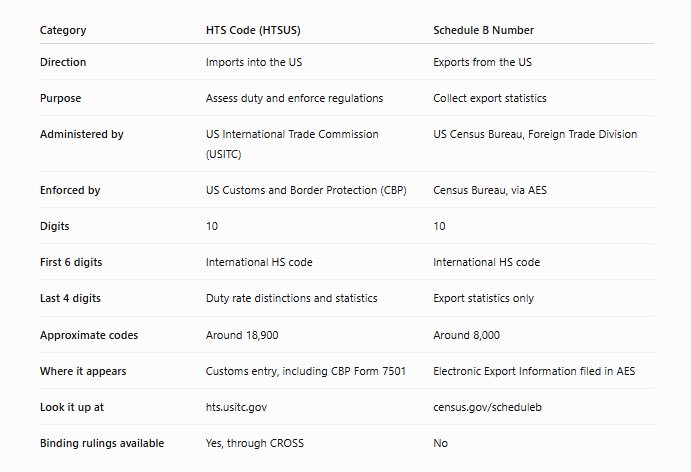
One Product, Two Different Codes
An example makes the divergence concrete. Take hand-held umbrellas, which sit in Chapter 66 of the Harmonized System.
Umbrellas: the same product, classified two ways
The international HS subheading is 6603.20. That six-digit number is the same in every WCO member country, and it is the number you would put on an international commercial invoice.
For export, the Schedule B number is 6603.20.0000. One code. The Census Bureau does not need to distinguish between types of umbrella, because no duty turns on the answer.
For import, the HTS splits into at least two codes: 6603.20.3000 covers hand-held umbrellas chiefly used for protection against rain, and 6603.20.9000 covers other hand-held umbrellas not chiefly used for protection against rain.
Same umbrella. First six digits identical. Last four digits completely different, and on the import side the choice between .3000 and .9000 changes what you owe.
This is the pattern across the tariff. The HTS subdivides where duty rates or trade programs differ. Schedule B collapses those distinctions because it only needs to count what left the country.
The Rule Is Not Symmetrical
Here is where most guides go wrong, and it is worth being precise because the two directions genuinely have different rules.
You can never use a Schedule B number for an import
This direction is absolute. Schedule B numbers cannot substitute for HTS codes on an import classification, ever. The HTS code is what determines your duty rate, and a Schedule B number simply does not carry that information. There is no exception, no threshold, and no circumstance where a Schedule B number is acceptable on a customs entry.
You can sometimes use an HTS code for an export
This direction is conditional, and the conditions matter. Because Schedule B is effectively a subset of the HTS, a company that has already classified its products under the HTS for import purposes may generally use those HTS codes on export filings too, which saves classifying the same product twice.
That option comes with two limits. First, certain HTS codes cannot be used for exporting at all. Second, where a product's Schedule B number is listed in the HTS Notice to Exporters, the Schedule B number must be used and the HTS code will not do. An exporter who assumes the HTS code is always fine can receive a fatal error in AES or a correction from the Census Bureau.
The accurate position, stated plainly
Schedule B for imports: never permitted.
HTS for exports: generally permitted, but not universally. Certain HTS codes are not valid for export, and where the Notice to Exporters specifies a Schedule B number, that Schedule B number is mandatory.
You will find guides that flatten this into 'always use Schedule B for exports' and others that flatten it into 'just use HTS for everything'. Both are oversimplifications. The safe practice is to verify each product rather than apply a blanket rule, and to confirm the code against the current schedule before you file.
When You Actually Need a Schedule B Number
Not every export requires a filing. Schedule B numbers are reported as part of the Electronic Export Information, or EEI, filed through the Automated Export System. That filing is generally required when the value of the commodity classified under a single Schedule B number exceeds $2,500 to a single destination, or when the shipment requires an export license regardless of value.
Note how the threshold works, because it is commonly misread. The $2,500 applies per Schedule B number, not per shipment. A consignment containing several different commodities is assessed line by line, so a shipment worth well over $2,500 in total may still fall below the threshold on each code. Shipments to Canada carry their own exceptions.
By contrast, there is no threshold on the import side. An HTS code is required to classify goods on every entry into the United States, whatever the value.
Where to Look Up Each Code
The two systems have two separate official tools, and using the wrong tool is the first step toward using the wrong code. For imports, search the Harmonized Tariff Schedule at the USITC, which is the authoritative source for HTS codes and their duty rates. For exports, use the Census Bureau's Schedule B search tool, which is free and updated to reflect changes in the schedule.
Two further resources are worth knowing. The Census Bureau publishes a concordance table mapping Schedule B codes to HTS codes, and the USITC publishes an HTS to Schedule B correlation. If you operate in both directions, keep both bookmarked, because they are how you move between systems without guessing.
For genuinely difficult import classifications, the Customs Rulings Online Search System, known as CROSS, contains legally binding rulings on HTS numbers for goods imported into the United States. CROSS cannot give you a binding ruling on a Schedule B number, since binding rulings do not exist on the export side, but a CROSS ruling still establishes the six digit HS subheading, which gives you a validated starting point for the Schedule B classification.
Both Systems Change, and They Did Not Change on the Same Day in 2026
Neither schedule is static, and this is where a code that was right last year quietly becomes wrong. The largest update usually lands on or about January 1 each year, but the two systems are maintained by different agencies and their timetables can drift apart.
The 2026 effective dates are different for each system
Exporters: the updated Schedule B codes took effect January 1, 2026, with a 30 day grace period beyond December 31, 2025 for outdated codes.
Importers: the updated HTS codes took effect February 1, 2026. The International Trade Commission announced a delay to the usual January 1 date because of the government shutdown.
If you classify in both directions, you had a month in early 2026 where the two schedules were on different vintages. Reporting a 2025 Schedule B code in 2026 is one of the most common export filing errors, and the equivalent applies on the import side.
Verify the current effective dates before you rely on this. Schedules change, and the point of this section is that you must check rather than assume.
Updates are more frequent than most importers realise. The USITC issued 10 revisions to the HTS in 2024 and 32 in 2025. Beyond the annual cycle, the World Customs Organization periodically overhauls the underlying Harmonized System itself. The current version is HS 2022, and the next major global update is expected in 2028, which will ripple through both the HTS and Schedule B. Reviewing your classifications is not a one-time exercise.
What Goes Wrong When You Use the Wrong Code
The consequences differ by direction, which is another reason the two systems deserve separate attention.
On an import entry, a wrong code means a wrong duty calculation. You may underpay, which creates exposure to penalties and interest when it is discovered, or overpay, which is money you will not automatically get back. A wrong code can also cost you a trade preference claim you were legitimately entitled to, because eligibility for programs such as USMCA is tied to classification. Misclassification is a compliance issue, and deliberate misclassification is considerably more than that.
On an export filing, a wrong code means a rejected or corrected AES filing. Using the ten digit HTS code where a Schedule B number is required is a recurring cause of fatal errors, and a pattern of incorrect EEI filings can create ongoing friction getting goods out of the country, along with fines and penalties.
The common thread is that the error hides. Because the first six digits are shared, a wrong ten-digit code passes a casual glance. It surfaces at the border, in an audit, or in a Census correction, which is always later and more expensive than catching it at classification.
Frequently Asked Questions
What is the difference between an HTS code and a Schedule B number?
An HTS code classifies goods imported into the United States and determines the duty rate. A Schedule B number classifies goods exported from the United States and is used for statistics. Both are ten digits and share the same first six, but the last four often differ, and they are administered by different agencies.
Can I use an HTS code instead of a Schedule B number?
Usually, but not always. Because Schedule B is effectively a subset of the HTS, many exporters use their HTS codes on export filings to avoid classifying twice. However, certain HTS codes cannot be used for export, and where a Schedule B number is listed in the HTS Notice to Exporters, that Schedule B number must be used.
Can I use a Schedule B number for an import?
No. This direction has no exceptions. Schedule B numbers cannot be used in place of HTS codes for import classification. Only the HTS code carries the duty rate information that CBP needs, so a Schedule B number is never acceptable on a customs entry.
Are HTS codes and Schedule B numbers the same length?
Yes. Both are ten digits, and both begin with the same six digit international Harmonized System code. The difference is in digits seven through ten, which the USITC structures for import duty purposes and the Census Bureau structures for export statistics.
When do I need to file a Schedule B number in AES?
Generally when the value of the commodity under a single Schedule B number exceeds $2,500 to a single destination, or when the export requires a license regardless of value. The threshold applies per Schedule B number rather than per shipment, and Canada has its own exceptions.
Which code goes on my commercial invoice?
For international documents, the six digit HS code is the safer choice. The last four digits of a ten digit code are country specific and may not be valid in the destination country, so a full US ten digit code on an international invoice can create confusion rather than clarity.
How often do these codes change?
More often than most importers expect. The main annual update usually lands around January 1, though the two systems can take effect on different dates. The USITC issued 32 revisions to the HTS in 2025 alone. The underlying Harmonized System is also updated periodically, with the next global revision expected in 2028.
Get the Classification Right the First Time
Classification is where the landed cost is actually decided. The right HTS code sets your duty rate, protects your trade preference claims, and keeps your entries clean, and the difference between the right code and a plausible one rarely announces itself until an audit. Clearit USA is a licensed, fully digital customs brokerage that classifies and files entries every day. If you are working out the correct code for a product or want your classifications reviewed before they cost you, our US customs clearance service can handle the classification and the entry so your duty is calculated correctly.
HOW DO YOU FEEL ABOUT FASHION?
COMMENT OR TAKE OUR PAGE READER SURVEY
Featured





Deep clean, seal, and protect your tile & grout in Oceanside, CA. Bring the original shine back to your floors. Request a quote today!