
Planning an RV Road Trip With a Ford Powerstroke Truck

PAGE
By PAGE Editor
A Ford Super Duty with a Powerstroke diesel is one of the most popular choices for towing travel trailers and fifth wheels, but a successful RV road trip depends on preparation as much as horsepower. Before you leave, confirm that your trailer fits within the truck’s towing and payload ratings, service the engine and cooling system, check tires and brakes on both truck and trailer, and plan a route with fuel stops suited to a long rig. With those basics covered, a Powerstroke can pull a heavy camper across mountains and deserts with confidence.
The goal is simple: spend your trip enjoying the scenery, not waiting for a tow truck.
Why Powerstroke Trucks Are Popular for RV Travel
Ford has offered Powerstroke diesel engines in its heavy-duty pickups since the mid-1990s, and several generations have built loyal followings. The early 7.3L is admired for its durability, while the 6.7L used in modern Super Duty trucks delivers far more power and torque along with modern emissions technology.
For RV owners, the appeal comes down to a few strengths. Diesel engines produce strong torque at low engine speeds, which makes pulling heavy loads up grades feel less strained. Many Super Duty trucks also offer integrated trailer brake controllers, exhaust braking on newer models and towing technology that makes hitching and maneuvering easier.
That said, every truck has limits, and the most important part of trip planning is understanding them.
Know Your Numbers Before You Hitch Up
Towing ratings vary widely depending on engine, axle ratio, cab style, bed length and whether the truck has single or dual rear wheels. These are the figures to check on your door sticker and owner’s manual:
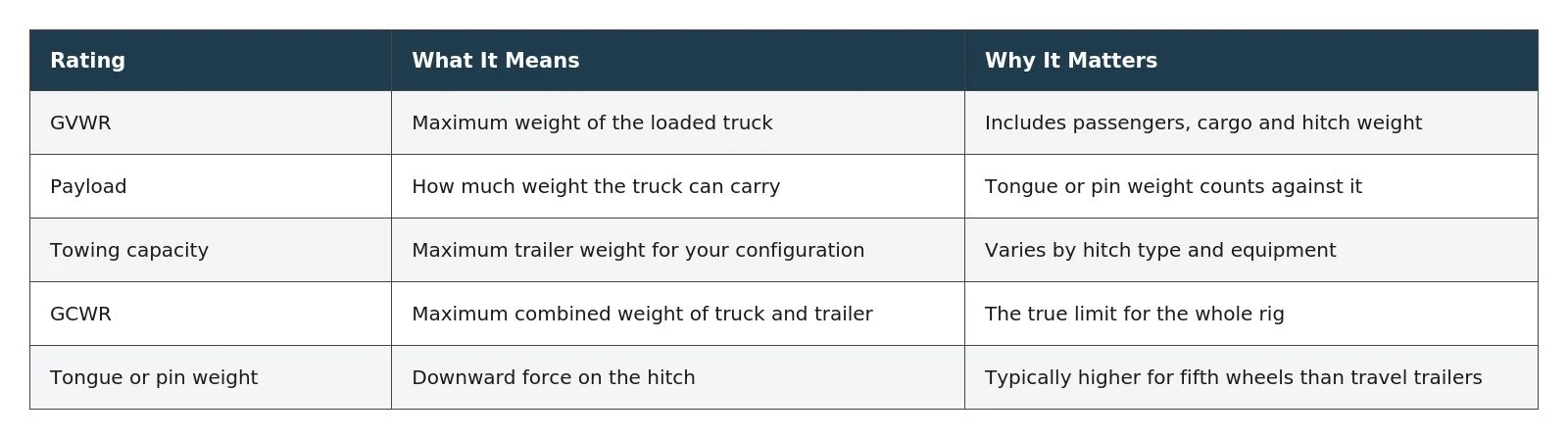
Payload is the number many RV owners overlook. A fifth wheel can place a substantial share of its weight on the truck’s bed, and that weight adds up quickly with passengers, coolers, firewood and gear. Weighing your loaded rig at a truck scale before a long trip is one of the best ways to avoid unsafe surprises.
A Pre-Trip Checklist for Your Truck
A few hours of preparation can prevent most roadside problems. Work through these steps a week or two before departure:
Change the oil and filters if service is due, including fuel filters, which are critical for diesel injection systems.
Inspect the cooling system. Check coolant level and condition, hoses and the radiator, since towing on hot days puts extra strain on cooling.
Check transmission fluid and follow the severe-duty maintenance schedule if you tow often.
Top up diesel exhaust fluid on newer trucks and pack an extra container if your route includes remote areas.
Examine tires on the truck and trailer for correct pressure, tread depth and signs of aging or cracking.
Test brakes and lights on both vehicles, including the trailer brake controller.
Inspect the hitch and safety chains, making sure pins, clips and breakaway cables are in good condition.
Older Powerstroke trucks deserve a little extra attention. Each generation has its known weak points, and catching worn parts before a trip is far cheaper than dealing with a breakdown hundreds of miles from home.
Upgrades Worth Considering
Many Powerstroke owners make a few targeted improvements before heavy towing seasons. The most useful upgrades focus on reliability and monitoring rather than raw power:
Engine gauges or monitors to track coolant temperature, transmission temperature and exhaust gas temperature
Upgraded fuel filtration to protect injectors from contaminated fuel on the road
Cooling system components that hold up better under sustained loads
Quality replacement parts for high-wear components such as sensors, hoses and belts
Suspension aids that help the truck stay level and stable with heavy hitch weight
When choosing diesel truck upgrades, make sure parts are designed for your specific engine generation and model year. Well-matched parts install correctly and are less likely to introduce new problems on a long journey.
It’s also important to keep emissions equipment intact on newer trucks. Removing or disabling it can violate federal and state laws, create inspection problems and affect resale value.
Driving Tips for Towing a Camper
Towing an RV changes how a truck accelerates, brakes and handles. A few habits make the experience safer and less tiring:
Leave more following distance than you would without a trailer, especially on downhill stretches.
Use tow/haul mode and engine or exhaust braking on long descents instead of riding the brakes.
Watch your gauges on steep climbs and ease off if temperatures start rising.
Take wide turns and plan lane changes early, since a trailer needs more space.
Stop every two to three hours to stretch, check tires, look at hitch connections and feel wheel hubs for excess heat.
Drive at moderate speeds. Trailer tires and stability are often the real limits, not engine power.
Wind and weather matter too. Large trailers catch crosswinds easily, so check the forecast and be ready to slow down or wait out strong gusts.
Planning the Route and Stops
A long truck and trailer combination can’t pull into every gas station or parking lot. Plan fuel stops at truck stops or stations with diesel lanes and enough space to turn around. Apps and websites designed for RV travelers can help you find campgrounds with pull-through sites, dump stations and roads suitable for larger rigs.
Mountain routes deserve special attention. Long grades test both engine cooling on the climb and brakes on the descent, so plan extra time and avoid scheduling tight arrival deadlines on hilly days.
Enjoy the Journey
A Powerstroke-powered Super Duty can be a fantastic partner for RV adventures, from weekend lake trips to cross-country journeys through national parks. The trucks have the muscle for the job, but careful preparation is what keeps a trip smooth.
Know your weight limits, service the truck before you leave, choose sensible upgrades and drive with patience. Do that, and you’ll spend more time around the campfire and less time on the shoulder of the highway.
HOW DO YOU FEEL ABOUT FASHION?
COMMENT OR TAKE OUR PAGE READER SURVEY
Featured





Certificate of Analysis is the primary document used to assess the quality, purity, and identity of synthesized peptides.