
The Invite-Only Problem: How Fashion Brands Keep Private Drops, VIP Groups and Digital Communities Trustworthy

PAGE
By PAGE Editor
Exclusivity has always been part of fashion’s machinery. Before digital communities, it took the form of private appointments, tightly controlled guest lists, showroom previews and whispered information about where the next release might appear. The internet did not remove that instinct. It simply made private access easier to distribute.
Today, a label can give a few hundred customers early access through a messaging group. A designer can share work-in-progress material with a small circle before a collection goes public. A retailer can use a private channel to coordinate a limited release without broadcasting every detail across its main social accounts.
The appeal is obvious. So is the weakness.
Private access works because people believe they are receiving something that is not meant for everyone. That same expectation makes impersonation unusually effective. A message that would look suspicious in an ordinary inbox can feel plausible when it says, “You’ve been selected,” “Members only,” or “Private link — do not share.”
For fashion brands, this creates a problem that is less about cybersecurity in the abstract and more about the design of trust. If exclusivity is part of the customer experience, verification has to be part of it too.

When Scarcity Changes the Way People Read a Message
Imagine a customer who has been following a small label for two years. She has bought from two previous drops and regularly replies to the brand’s Instagram stories.
The evening before a new collection launches, she receives a message saying she has been added to a private early-access group. The profile image matches the campaign. The language sounds familiar. The link opens a legitimate messaging platform.
Nothing looks obviously wrong.
That is precisely why this type of situation deserves more attention than the usual advice to “check for spelling mistakes” or “avoid suspicious links.” Modern impersonation does not need to look amateurish. Public campaign photography, collection names, captions and launch dates are readily available. A convincing copy can be assembled from material the brand itself has already published.
The more useful question is not, “Does this look professional?”
It is, “Can I verify where this invitation originated?”
That distinction sounds small, but it changes the entire trust model.
A Genuine Platform Is Not the Same as a Genuine Brand Space
One of the most persistent sources of confusion in private digital communities is the assumption that an authentic platform guarantees an authentic account inside it.
It does not.
A link can genuinely open Telegram, Discord or another established service while leading to a community that has no connection to the brand named in its title. The platform may be real; the identity claim may not be.
For customers, that means verification has two layers. First, confirm that the platform itself is what it claims to be. Then confirm that the particular group, channel or account is connected to the brand.
This matters especially when an invitation arrives outside the brand’s usual communications. A Traditional Chinese-speaking customer who is unfamiliar with Telegram’s official web properties, for instance, may first want to establish which domains and entry points actually belong to the service. A reference such as this Telegram 官方入口驗證指南 can be useful at that stage—not as proof that a particular fashion group is official, but as a way to separate platform verification from brand verification.
The second step still belongs to the fashion label.
If the brand operates a private community, there should be some route back to a property it controls.
The Strongest Trust Signal Is Usually Boring
Fashion marketing tends to value novelty. Trust infrastructure often benefits from the opposite.
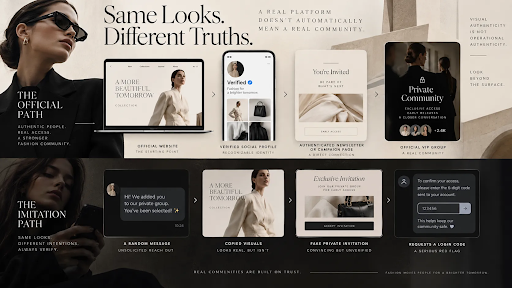
A customer should be able to move from an official brand property to a private community through a predictable chain: the brand website, a verified social profile, a known newsletter or an authenticated customer account.
That process does not need to destroy the sense of exclusivity. A label does not have to publish every private invitation on its homepage. It simply needs to make the method of distribution clear.
For example:
Early-access invitations are distributed only through our customer email list and verified social accounts.
That sentence is not glamorous, but it gives customers something valuable: an independent test.
If a supposed VIP invitation arrives through an unrelated account, the recipient knows it does not match the brand’s stated process.
This is where some private-community strategies fail. They focus heavily on the experience after someone enters the group but give very little thought to how a customer verifies the invitation before joining.
Visual Authenticity Is Becoming a Weaker Form of Evidence
Fashion is especially exposed to this problem because its identity systems are so visible.
Campaign photography, color palettes, typography, product names and tone of voice are designed to be recognisable. They are also easy to reproduce.
A lookalike community does not need access to private brand assets to appear convincing. It can use the same campaign image as the official account, repeat language from a launch announcement and copy product photography directly from the website.
AI-generated imagery and synthetic creative make the problem even less dependent on simple copying. A fraudulent page can now produce content that feels consistent with a brand without reproducing any individual asset exactly.
This does not mean visual identity has lost its value. It means it should no longer carry the burden of verification by itself.
A page can look like the brand and still not belong to the brand.
For marketing teams, that is an operational issue as much as a customer-safety issue. The stronger and more recognisable a campaign becomes, the easier it may be for outsiders to imitate its surface language.
Old Communities Create Their Own Kind of Confusion
Not every misleading community begins as a fake.
Fashion campaigns are temporary by nature. Private groups built around a Spring/Summer collection, a pop-up, a collaboration or a regional launch may remain accessible long after the campaign ends.
Search results and old social posts have longer memories than marketing calendars.
A customer searching six months later may find an old group that was once legitimate but is no longer maintained. The description still carries the brand name. The profile image may still show the last campaign. Nothing clearly indicates that the group is dormant.
That creates a different trust problem: stale authenticity.
Brands that use private communities should therefore treat them as assets with a lifecycle. Someone should know who owns the space, what campaign it belongs to, when it should be retired and what happens to the link afterward.
If the community closes, say so. If it moves, leave a clear pointer to the new destination. If it remains open only as an archive, label it accordingly.
The absence of malicious intent does not make an abandoned brand space harmless.
Influencers Make Verification More Complicated, Not Less Important
Many fashion launches are intentionally distributed through people outside the brand’s core accounts.
A stylist may share a fitting-room preview. A musician involved in a collaboration may distribute an early-access link. An ambassador may invite followers into a temporary community.
That is normal.
What matters is whether the relationship is legible.
Customers should be able to distinguish between an official brand-operated space, an authorised campaign community and an independent fan group. None of those categories is inherently illegitimate. Problems begin when the distinction is hidden.
Fan communities, in particular, do not need to imitate official status to be valuable. Some of the most interesting conversations around fashion happen precisely because they are independent of brand management.
A simple label such as “Independent fan community — not operated by the brand” can increase credibility rather than diminish it.
Transparency is often more persuasive than borrowed authority.
“Verification” Should Never Mean Handing Over an Account
Private access also creates opportunities for a more serious form of manipulation.
Someone joins what appears to be an early-access group and is told that one final step is required before the drop becomes visible. They may be asked to send a login code, approve an unfamiliar device, scan a QR code or provide another credential under the language of “membership verification.”
That request should be treated differently from an ordinary brand-membership check.
A fashion label may reasonably confirm an email address, purchase history, invitation token or loyalty status. It has no legitimate reason to ask a customer to surrender credentials that control an unrelated messaging account.
This is an area where brands can remove ambiguity simply by stating the rule in advance.
Community onboarding material can say, plainly:
We will never ask for your messaging-app password, login code or account-recovery credentials.
That is far more useful than assuming customers already understand every platform-specific security mechanism.
For readers who use Telegram in Traditional Chinese and want to understand the difference between login codes, device authorisation and active sessions, an 電報帳號安全指南 can provide the account-security background. The brand’s responsibility, however, remains straightforward: membership verification should never require control of a customer’s personal account.
Drop-Day Information Needs One Authoritative Version
Private groups become most chaotic precisely when they are most valuable: just before a release.
Launch times move. Venue instructions change. A product allocation shifts. A new pickup point is added. Someone screenshots yesterday’s message and reposts it twenty messages later.
Within minutes, several versions of the “current” information may be circulating at once.
Brands can reduce that problem by adopting a canonical update pattern.
A drop message should make the essentials obvious:
the name of the release;
the current date and time;
the official product or campaign page;
the current community or event link;
any change from a previous announcement;
what the brand will never ask customers to provide.
When details change, the update should explicitly replace the previous version.
“Updated launch time: 19:00 CET. This replaces the 18:00 time shared yesterday.”
That is much harder to misread than:
“New time!”
The principle is simple: private communication can be informal, but operational information should not be ambiguous.
A Private Group Should Not Become the Brand’s Only Memory
Messaging communities are good at immediacy and weak at permanence.
A designer Q&A may be fascinating while it is happening. A styling conversation may reveal how customers actually use a product. A private event thread may contain information worth preserving.
But chronological chat is a poor archive.
When valuable material appears inside a private community, the brand should decide whether some of it belongs elsewhere later: a campaign archive, editorial feature, FAQ, customer-support article or lookbook.
The distinction is useful:
A community is where interaction happens.
An archive is where reference survives.
Treating one as a substitute for the other eventually makes both harder to use.
A Simple Audit Before a Major Release
Brands do not need a complex security programme to discover many of these weaknesses. A basic impersonation audit before a major launch can reveal a surprising amount.
Search the brand name together with terms such as “VIP,” “private group,” “Telegram,” “Discord,” “early access” and the current collection name.
Then look at the results as a customer would.
Can you immediately tell which spaces belong to the brand? Are former campaign groups still appearing? Are fan communities clearly labelled? Can the current official link be traced back to the website or verified social profiles? Does any page ask visitors to provide information that a brand should not need?
The point of this exercise is not to eliminate every unofficial discussion of the label. That would be unrealistic and, culturally, probably undesirable.
The goal is to make sure the official path is easier to recognise than the imitation.
Exclusivity Works Better When Trust Is Visible
Private digital communities can offer something public social feeds rarely do well: a sense of proximity.
For independent designers, they can create direct relationships with a small group of committed customers. For established labels, they can make a release feel less like a mass broadcast and more like participation in a particular cultural moment.
That value is worth preserving.
But exclusivity should not depend on ambiguity. Customers should know how an invitation reached them, where they can verify it, what information a legitimate community will never request and what happens when a campaign ends.
The strongest private experiences do not ask people to choose between excitement and caution.
They make trust part of the invitation.
HOW DO YOU FEEL ABOUT FASHION?
COMMENT OR TAKE OUR PAGE READER SURVEY
Featured





Video is no longer optional for marketing teams, e-commerce brands, and solo creators.