
Why Fabric Certification Matters When Buying Underwear
PAGE
By PAGE Editor
A few years ago I bought a pack of underwear from a roadside stall because the price was too good to ignore. By the second wash the colour had bled onto everything else in the machine, and by the end of the week I had an itchy rash I couldn't explain. I blamed the weather, then my soap, and only later worked out that it was the underwear.
That's the trouble with fabric. You can see the print and feel the softness in your hand, but you can't see what went into making it. Dyes, finishing agents, and chemical treatments all end up against your skin, and none of them show up on the front of the pack.
That's where certification comes in. It isn't the most exciting topic, but if you wear underwear every day, it's worth understanding.
Why Underwear Is Different From Other Clothes
A jacket sits over a shirt, and a shirt sits over an undershirt. Underwear sits directly on skin, for most of the day, in warm and often damp conditions. That combination matters for a few reasons.
The skin there is sensitive. It reacts faster to irritants than skin on your arms or back.
Heat and sweat change things. When fabric gets damp and warm, whatever is in it can transfer to skin more easily.
The contact is long. You aren't wearing it for an hour. You're wearing it for twelve, sixteen, sometimes twenty-four.
So while it's reasonable not to worry much about the chemistry of a winter coat, underwear deserves a closer look.
What Goes Into Fabric That You Never See
Turning raw cotton or fibre into a finished, coloured garment takes many steps: bleaching, dyeing, softening, and various finishing treatments to control shrinkage, colour, or feel. Depending on how a manufacturer handles them, residues from some of these processes can remain in the finished product.
Most of the time this isn't dramatic. But cheap production without proper controls is exactly where you're more likely to find irritating residues, strong chemical smells, or dyes that bleed heavily. Those are the pairs that cause itching, redness, or discomfort, particularly for people with sensitive skin.
What "Certified Fabric" Actually Means
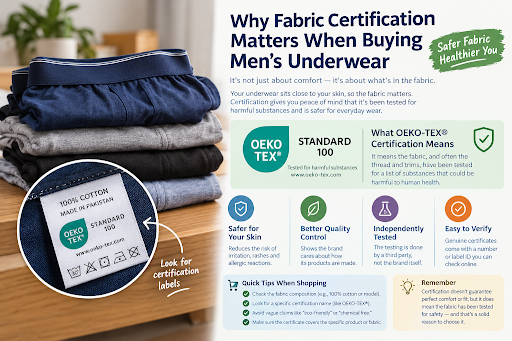
A certification is a third party checking a product against a set standard, rather than a brand simply saying its product is good. One of the best-known in textiles is OEKO-TEX®, and its widely recognised STANDARD 100 label. In simple terms, OEKO-TEX certification means that the fabric, and often the components like thread and trims, have been tested for a list of substances that could be harmful to human health.
The important idea is that an independent lab did the testing. The brand isn't grading its own homework.
A few things worth knowing:
Certification covers testing, not comfort. A certified fabric can still be a poor fit or badly stitched. It tells you about safety, not quality of design.
It's tied to specific products. Certificates typically cover particular articles or fabrics, which is why a brand should be able to tell you which of its products carry it.
It's checkable. Genuine certificates come with a number or label ID you can usually verify on the certifier's website.
That last point is a good habit: if a brand says its fabric is certified, it's reasonable to ask which certification, and to look for details.
Why It Matters for Your Skin
If you've ever had persistent itching, redness, or a rash in the underwear area with no obvious cause, fabric could be a factor. It might be moisture trapped by a synthetic blend, rough stitching, or a chemical irritant from the finishing process.
Certified fabric can't guarantee you'll never have a reaction, because everyone's skin is different. But it does reduce the odds of coming into daily contact with problematic substances, which is a sensible thing to want from something you wear this closely.
If irritation keeps happening even after you've switched to soft, breathable, tested fabric, speak to a doctor rather than guessing.
It's Not Just About Safety: The Quality Signal
Here's a less obvious benefit. A brand that pays for testing and certification is usually a brand that cares about how its products are made. Fabric that's properly tested and controlled tends to be produced by manufacturers with consistent processes, and that shows up in day-to-day ways: colours that don't bleed, fabric that doesn't go stiff, and stitching that holds.
It's not a guarantee, but it's a useful signal, like a restaurant that displays its hygiene rating. The fact that they're willing to be checked tells you something.
How to Read the Labels You'll Actually See
When you're shopping, keep an eye out for these:
The fabric composition. Look for the actual cotton or modal percentage, not just the word "cotton." For everyday comfort, men cotton underwear with a clearly stated composition is a good start.
A named certification. A specific name like OEKO-TEX® is more meaningful than vague phrases such as "eco-friendly," "premium safe," or "chemical free."
Where the details live. Brands that are proud of their certification usually explain it on a dedicated page rather than hiding it. Savys, for example, explains its approach on its certifications page, and says it selects OEKO-TEX® certified fabrics tested for harmful substances.
Care instructions. Clear washing guidance generally points to a brand that thought about the whole product.
Be sceptical of any claim that sounds impressive but names nothing. "Certified" without saying by whom isn't much of a promise.
Certification vs Marketing Language
It helps to know the difference between a real certification and a marketing phrase.
A real certification names the standard, is issued by an independent body, applies to specific products, and can be verified.
A marketing phrase sounds reassuring but can mean anything. Words like "natural," "pure," "skin-friendly," or "eco-conscious" aren't regulated in the same way, so brands can use them freely.
Neither is bad on its own, and many good products use friendly language. The point is to look for something concrete behind it.
What Certification Doesn't Tell You
To be fair, certification isn't everything.
It doesn't guarantee fit or comfort. You still need to check size, waistband, and seams.
A safety certification isn't the same as a sustainability claim. Testing for harmful substances is one thing, and how a garment is produced, packaged, and shipped is another. Both matter, but they aren't the same.
It doesn't replace common sense. Wash new pairs before wearing, and stop using anything that irritates you.
The best approach is to use certification as one filter among several, alongside fabric, fit, and construction.
Matching Fabric, Fit, and Certification
Here's a simple way to bring it together when you're buying.
Step 1: Start with the fabric. Breathable natural fibres like cotton, or soft modal such as modal boxershorts, are good places to start for daily wear.
Step 2: Check for a named certification. Look for details on the product page or the brand's site.
Step 3: Choose the right cut for your day. Relaxed men boxers suit hot weather and home, while a long leg boxer brief helps if you deal with chafing.
Step 4: Check the size chart. Sizes vary between brands, so measure before you buy.
Step 5: Look at the seams and waistband. Flat stitching and a soft, secure band matter as much as anything on the label.
Looking After Certified Fabric
Good fabric lasts longer when treated well. A few simple habits help:
Wash new pairs before the first wear.
Use cool or lukewarm water.
Avoid harsh bleach, which weakens fibres and elastic.
Don't over-dry, especially at high heat.
Rotate your pairs so no single one wears out first.
Buying quality also connects to sustainability in a practical way: something that lasts a year or two means fewer replacements and less waste. If you're refreshing your drawer, multi-packs and saver packs are usually cheaper per piece than singles.
FAQs
1. What does OEKO-TEX® certified fabric mean?
It means the fabric has been tested by an independent body for a list of substances that could be harmful to health. It gives you more confidence about safety, though it doesn't tell you anything about fit or design.
2. Is certified underwear better for sensitive skin?
It can lower the chance of contact with problematic substances, which is helpful if your skin reacts easily. It doesn't guarantee you won't have a reaction, since fabric type, fit, and moisture also play a part. If irritation continues, see a doctor.
3. How can I check if a brand's fabric certification is genuine?
Look for the certification name and, where possible, a certificate or label number. Genuine certifications can usually be verified on the certifier's official website, and reliable brands will explain their certification on their site.
4. Does certified fabric mean the underwear is sustainable?
Not necessarily. Certification for harmful substances is about product safety, while sustainability covers wider things like production, packaging, and durability. Both matter, but they are separate questions.
5. Should I wash certified underwear before wearing it?
Yes, it's a good habit for any new garment. A wash before the first wear removes dust and handling residue from packing and shipping.
Final Thoughts
Underwear is one of the few things you wear every single day without a break, right against some of your most sensitive skin. It makes sense to care about what's in it, even though you can't see it.
Certification won't make a badly designed pair comfortable, and it isn't a magic label. But it's a useful piece of evidence that someone independent looked at the fabric and checked it against a standard. Combined with breathable material, a good fit, and solid stitching, it helps you choose with more confidence.
So next time you're shopping, look past the print and the price. Check the fabric, look for a named certification, and ask questions if the details aren't clear. You can browse the full men underwear range to see how different fabrics and cuts compare. Your skin will notice the difference long before you do.
HOW DO YOU FEEL ABOUT FASHION?
COMMENT OR TAKE OUR PAGE READER SURVEY
Featured




A comfortable home should offer more than a place to sleep and eat.