
Why "Normal" Blood Work Delays Low Testosterone Treatment (And How to Treat the Symptoms, Not Just the Numbers)

PAGE
By Finixio Digital
You know your body better than anyone else. When you start experiencing relentless fatigue, a sudden inability to focus, and a vanishing sex drive, you know something is wrong. You finally make an appointment, get your blood drawn, and wait anxiously for the results.
A few days later, your doctor calls to say everything looks "fine." Your testosterone levels are technically in the normal range. There is no prescription, no treatment plan, and no explanation for why you feel terrible.
True hormone optimization requires looking far beyond broad lab averages. To actually restore your energy and quality of life, doctors must evaluate your complex blood chemistry and treat your actual clinical symptoms.
The Problem with "Normal": Why You Feel Terrible Despite Reassuring Labs
Why do you have clear symptoms of low testosterone if your blood work came back completely normal? The answer lies in how the medical system defines that word.
To understand the disconnect between your doctor's assessment and your physical reality, you have to look at the baseline medical standard. Currently, the American Urological Association (AUA) defines low testosterone as a total testosterone level below 300 ng/dL.
This broad threshold creates a massive blind spot in men's health. The "normal" range often stretches anywhere from 300 to 1,000 ng/dL depending on the specific lab running the test. This means a man with a level of 350 ng/dL is considered perfectly healthy on paper. However, if his body naturally operated at 700 ng/dL for most of his life, a drop to 350 ng/dL represents a severe hormonal crash. He will undoubtedly experience intense symptoms, even though he technically passed the test.
Many men find themselves completely dismissed by traditional clinics because their total testosterone barely scrapes the bottom of this acceptable range. Primary care doctors see a number just above 300 and refuse to investigate further.
You do not have to accept feeling like a shadow of yourself. If you are experiencing fatigue, brain fog, and low libido despite reassuring lab results, it is vital to seek out low testosterone treatment in NYC from specialists who prioritize how you feel over rigid lab thresholds. Treating the patient always matters more than treating the spreadsheet.
Decoding Your Blood Work: Total Testosterone vs. Free Testosterone
When you look at your lab report, you will likely see several different metrics. Understanding the difference between total testosterone and free testosterone is the secret to finally making sense of your symptoms.
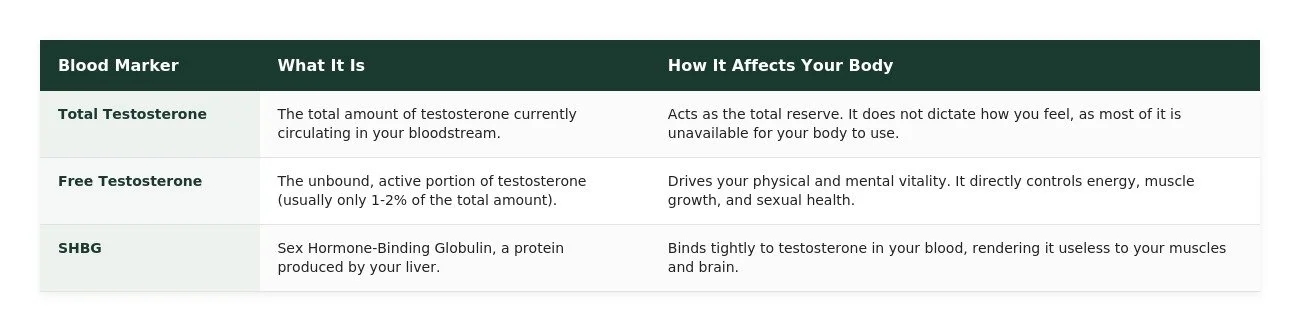
Total testosterone represents the overall reservoir of the hormone in your bloodstream. It is the big number at the top of your lab sheet. However, total testosterone does not indicate how much of that hormone your body can actually use. Much of it is bound to proteins and completely inactive.
Free testosterone is the bioavailable hormone that your tissues and organs can easily absorb. This is the portion of testosterone that actively impacts your energy, preserves your muscle mass, regulates your mood, and fuels your libido. You can have an impressive amount of total testosterone in reserve, but if your free testosterone is low, you will feel all the classic signs of hormonal decline.
To make sense of your lab results, we can break down the three most important markers in your blood work:
The Low Testosterone Symptoms You Shouldn't Ignore
Numbers on a page are subjective, but your lived experience is not. If your free testosterone is low, your body will sound the alarm through a variety of systemic physical and mental changes.
What are the actual symptoms of low testosterone you should be looking out for?
Physical and Metabolic Symptoms: The most common sign is chronic, bone-deep fatigue that does not improve with a good night's sleep. You might notice a rapid loss of lean muscle mass despite maintaining your gym routine. Additionally, many men experience sudden weight gain, specifically an increase in stubborn belly fat.
Cognitive Symptoms: Hormones heavily dictate brain function. A drop in free testosterone often causes severe brain fog, making it difficult to recall words or maintain mental focus during work meetings. You may also experience sudden mood shifts, increased irritability, or a lowered tolerance for daily stress.
Sexual and Reproductive Symptoms: A noticeable drop in libido is often the first symptom that prompts men to seek help. This can manifest as a total lack of interest in sex or a decline in morning erections. Many men also begin to experience varying degrees of erectile dysfunction as their hormone levels crash.
These changes rarely happen overnight. They creep up slowly, making it easy to blame a demanding career or a busy family life.
Why Traditional Clinics Turn Away "Borderline" Cases
If the symptoms are so clear, why do traditional clinics refuse treatment for borderline cases? It comes down to how conventional medicine and the insurance industry operate.
General practitioners and standard medical clinics are bound by incredibly rigid lab protocols. Doctors are trained to look for diseases, not to optimize wellness. If your total testosterone registers at 310 ng/dL, an insurance company views you as healthy. A general practitioner will rarely prescribe hormone therapy in this scenario because it falls outside of standard, insurance-approved treatment guidelines.
Instead of investigating the nuance of your free testosterone or SHBG, conventional medicine often lazily writes off these symptoms as "just normal aging." You are told to get more sleep, eat better, and simply accept that getting older means feeling tired and weak.
This approach is fundamentally flawed. True patient care means that clinical symptoms matter significantly more than arbitrary numbers. A proactive medical approach doesn't ask "are you dying?"—it asks "are you thriving?"
The "Whole-Man" Approach to Hormone Optimization
How do you find a doctor who treats your symptoms instead of just your lab numbers? You look for specialists who practice a "whole-man" approach to endocrinology and urology.
A proper, in-depth evaluation does not happen in a rushed 15-minute appointment. It requires a comprehensive 90-minute visit to map out your full body chemistry. This includes evaluating your thyroid function, DHEA, estradiol, and complete blood count, alongside taking a detailed clinical history. A good specialist also provides mental health support, recognizing the immense toll that long-term fatigue and sexual dysfunction take on your mind.
Once your specific deficiencies are identified, you need customized delivery options. Cookie-cutter treatments rarely work for complex hormonal issues. Precise methods like hormone pellets and injections are heavily favored in specialized clinics, chosen by roughly 90% of patients for their flexibility and steady release.
It is important to set realistic expectations for your recovery. Hormone optimization is not a quick fix or an overnight miracle. Sustainable hormone balancing and vitality restoration builds safely over a 12-month period. This process requires structured, long-term monitoring to continuously adjust your dosage based on how you feel, ensuring you achieve the best possible quality of life.
Conclusion
You do not have to accept feeling exhausted, unfocused, and physically weak just because a piece of paper says your labs are technically "normal." Standard testosterone tests offer an incomplete picture of your health, completely missing the crucial role that free testosterone and SHBG play in your daily vitality.
Investigating your free testosterone and aggressively addressing your clinical symptoms is the key to true, lasting wellness. When you shift the focus from boosting an arbitrary number to resolving your actual physical complaints, everything changes. Finding a medical team that listens to your symptoms is the first and most vital step to regaining your energy and feeling like yourself again.
HOW DO YOU FEEL ABOUT FASHION?
COMMENT OR TAKE OUR PAGE READER SURVEY
Featured





Finding the right job in human resources or recruitment can take time, especially when you're searching online.