
How to Build a Profitable CBD Retail Business in 2026
PAGE
By PAGE Editor
Most CBD stores that close in their first two years make the same mistake: they treat sourcing as a commodity decision and compliance as an afterthought. The ones that survive treat both as the actual business. This guide is for founders, store owners, and category buyers who want a realistic, operational picture of what it takes to launch or grow a CBD retail operation in 2026 without getting caught flat-footed by a market that has genuinely changed since 2023. You'll come away with a framework for evaluating suppliers, a clear read on where the regulatory ground shifted last year, a data-backed picture of which product categories are pulling sales, and a practical checklist you can use before signing any wholesale agreement.
The Market Is Still Growing, but It's Also Getting Serious
U.S. CBD sales climbed from $108 million in 2014 to roughly $4.17 billion between 2022 and 2026. That's not a niche anymore. It's a category, and categories attract professional competition. Nearly 60% of American adults have tried CBD, primarily for pain, anxiety, and insomnia. That adoption curve is past the "curious early adopter" stage. The people walking into your store in 2026 have often tried two or three brands already. They're not asking what CBD is. They're asking why they should buy yours.
As people become more cannabinoid-savvy, they tend to seek clear labeling, precise dosing, and trustworthy product information as they grow in comfort over product selection from a very new market. In practical terms, that means a messy shelf with unlabeled COA access will lose to a clean, transparent competitor almost every time. Your merchandising is your first compliance signal.
E-commerce channels dominate, with around 40% of sales occurring online. That's a real number worth sitting with if you're planning a brick-and-mortar-only model. Your physical store needs a reason to exist beyond convenience, which usually means staff expertise, in-store testing formats, or a tight local community identity. If you can't articulate that reason, build the online channel first.
What Actually Changed in Late 2025 (and Why It Matters for Your Inventory)
Here's where a lot of retailers are getting caught off guard. Hemp-derived CBD remains federally legal under the 2018 Farm Bill framework, but a major change is coming: Section 781, signed in November 2025, takes effect November 12, 2026. After that date, finished CBD products must contain 0.4 milligrams or less of total THC per container.
Most current full-spectrum products cannot meet that threshold. If your supplier has not already started reformulating their full-spectrum SKUs, you need to have that conversation now, not in October. Clearing out non-compliant inventory after the deadline is a cash flow hit that most small retailers cannot absorb.
The practical move is to audit your current catalog against the 0.4mg THC-per-container standard and flag anything that fails. Broad-spectrum and isolate-based products generally clear the bar. Full-spectrum tinctures with a standard 25mg-per-mL CBD concentration are the riskiest category. Get updated COAs on those SKUs specifically.
The Three Supplier Sourcing Models (and Which One Fits Your Stage)
Before you think about specific SKUs, you need to decide how you want to source. There are really three options, and each one has a different capital profile and operational load.
Reselling an established brand gives you instant shelf recognition and removes most of the compliance documentation burden from your plate. The tradeoff is thinner margin, and you're dependent on someone else's supply chain reliability. This is the right call for year one if you're still learning the customer before committing to a private label.
White-label sourcing lets you build brand equity faster. If you want to establish a company with your own brand of CBD products, find a supplier that will package their products with your brand on the labels. You may be required to buy your product wholesale and manage your own inventory and shipping, so be prepared for a financial investment upfront. This is where most mid-stage CBD retailers land, and it's also where the most compliance risk sits if you don't vet the supplier properly.
Manufacturing your own products is the highest-margin path and the highest-complexity one. You need to source a compliant isolate or distillate, understand extraction and formulation basics, and build your own lab-testing relationships. Realistic for year three or beyond, not year one.
For most founders reading this, the white-label model combined with a small selection of established brand anchors is the most defensible middle ground. It gives you margin, control, and brand building without betting the entire operation on your own manufacturing quality before you've proven the customer.
Supplier Vetting: The COA Framework That Protects Your Store
This is the section that most business guides skip, so it's worth slowing down here. A Certificate of Analysis is only as useful as the lab that produced it and the process you use to verify it.
According to a 2024 FDA warning letter analysis, 47% of CBD products tested contained less than 80% of their stated CBD content, and the majority of those failures traced back to white label arrangements where the retailer never verified the supplier's COA independently. Nearly half. That's not an edge case risk. That's a category-wide quality problem, and your customers will eventually test your products themselves.
Request full-panel COAs for the exact SKU you're purchasing, then verify those COAs with an independent third-party lab. Full-panel testing includes cannabinoid potency, residual solvents, pesticides, heavy metals, and microbial contaminants.
Here's a vetting sequence I'd call the Four-Batch Rule. Before committing to any supplier for a white-label or bulk arrangement, request COAs from at least four distinct production batches spread across two to three months.
Batch-to-batch variations in purity, heavy metals, or residual solvents indicate unstable processes or unreliable upstream suppliers. A single clean COA from a supplier is a marketing document. Four consistent COAs across multiple months are evidence.
Also confirm the testing lab's credentials. Every lot should ship with a third-party COA from an ISO 17025 accredited, DEA-registered testing laboratory covering cannabinoid panel, heavy metals, pesticides, residual solvents, and microbials. If a supplier cannot name the lab or show accreditation documentation, that's a disqualifier.
"The brands that scale profitably are not the ones with the lowest supplier pricing. They're the ones that treat supplier vetting as non-negotiable and build margin assumptions around post-testing costs from day one.", Seabedee sourcing team, via white-label CBD sourcing guide, 2026
Building independent verification costs into your operating budget from day one separates retailers who survive audits from ones who get surprised by them. Budget roughly $150 to $300 per product SKU for independent batch retesting. Treat it as a cost of goods, not an optional expense.
Which Product Categories Are Actually Moving in 2026
The broad wellness pitch is done. CBD isn't just about general wellness anymore. As the market matures, personalization is becoming a key differentiator. Products formulated for specific outcomes are seeing increased demand. Your buyers want a sleep product, a focus product, a recovery product. They don't want a generic "wellness" label.
Cannabinoids like CBG, THCV, and CBN are gaining attention for their unique properties. Developing those products and educating customers about their potential will help CBD retailers stand out. If your shelf only carries CBD isolate gummies and a few tinctures, you're stocked for 2021, not 2026.
The sober curious movement is pushing demand for CBD-infused beverages, creating an inclusive social experience without the alcohol. Functional beverages are one of the fastest-turning categories in wellness retail right now, and they tend to bring in repeat buyers who are already habitual shoppers.
The pet CBD market is expected to exceed $1.1 billion. If you have the shelf space and your license covers pet products, this is a low-competition add-on with high basket attachment. Pet owners who already trust you for their own CBD purchases are a natural audience.
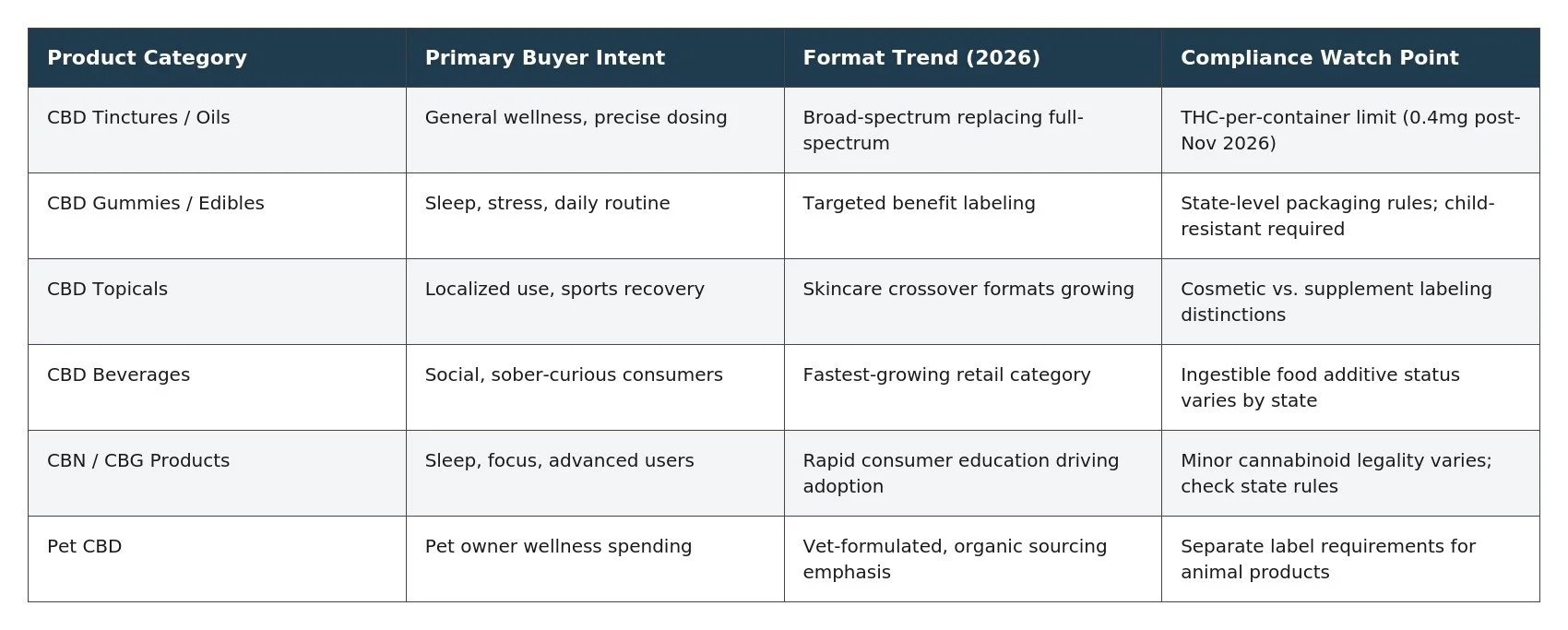
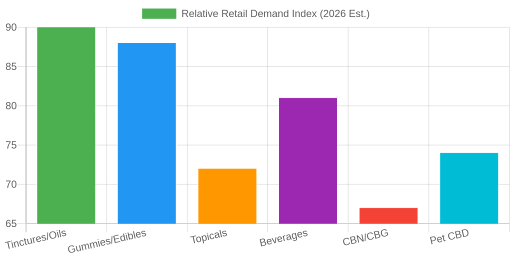
Below is a snapshot of how key product categories stack up by demand driver and buyer profile. Use this as a rough inventory planning grid, not a guarantee of sales velocity in your specific market.
Licensing and Packaging: The Part Nobody Prepares For Early Enough
Licensing is not a one-time checkbox. It's an ongoing operational requirement that varies by state and changes as your product mix changes. A resale license allows cannabidiol businesses to sell products sourced from wholesalers. If you procure cannabidiol products from a wholesale supplier, you'll likely require a resale permit. Considering most cannabidiol retailers aren't manufacturers or wholesalers, this is one of the most common forms of cannabidiol licenses.
Start there, but confirm what additional state-specific hemp retail permits apply in your jurisdiction. Some states have a dedicated consumable hemp product license on top of the standard business and resale permits.
On packaging: QR codes linking to third-party lab results are now a de facto requirement for any brand selling through major retail channels. Many retailers will not stock CBD products without accessible, batch-specific COA data. If you're building your own white-label line and you plan to wholesale to other retailers eventually, QR-linked COA access isn't optional. Build it into your label design from the start.
Also, both Amazon and Etsy prohibit CBD product listings as of 2026. If your online sales plan depends on marketplace traffic, redirect that energy toward your own DTC site and Google Shopping compliance, or toward a CBD-friendly marketplace. Plan your payment processing carefully too. Budget for higher processing fees, since mainstream processors typically don't work with CBD businesses.
Pre-Order Supplier Checklist: 9 Non-Negotiable Verifications
Use this before committing to any new supplier relationship, whether you're placing your first order or evaluating a new vendor for an expanded category.
Confirm the supplier holds a current USDA hemp license or sources from licensed cultivators.
Request COAs from four separate batches spanning at least 60 days.
Verify the testing lab is ISO 17025 accredited and DEA-registered.
Confirm full-panel testing covers potency, heavy metals, pesticides, residual solvents, and microbials.
Ask explicitly whether any SKUs contain more than 0.4mg total THC per container, and get that answer in writing before November 2026.
Confirm cGMP-compliant manufacturing and request facility documentation.
Review the supplier's labeling templates against your state's packaging requirements before printing anything.
Clarify minimum order quantities, reorder lead times, and stock availability guarantees. A supplier who routinely goes out of stock on your top seller will cost you more than a slightly higher price per unit from a reliable partner.
Run one independent verification test on the first received batch before it hits your shelf. This is the step most retailers skip and the one that matters most.
When you're sourcing finished-goods wholesale cbd products for your retail operation, the compliance documentation a supplier provides before the purchase order is the clearest signal of how seriously they'll support you after it. Prioritize transparency over price at the supplier selection stage, and you'll have far fewer surprises at the shelf.
Building Repeat Business: The Retention Angle Most CBD Retailers Miss
Customer acquisition in CBD retail is expensive. The product doesn't have the impulse-buy profile of a convenience item. Most buyers research before purchasing, which means your conversion cost is real. The stores that build durable revenue focus obsessively on the second and third purchase. That means staff who can have a real conversation about cannabinoids, not just read the label back to the customer. It means a loyalty program built around replenishment cycles, because most CBD consumers who find a product they like buy on a roughly 30-day cadence. And it means stocking complementary SKUs that make logical basket sense together: a sleep tincture alongside a CBN gummy, a topical alongside a recovery beverage.
As customers become more educated about CBD, developing products in CBG, THCV, and CBN and educating customers about their potential will help CBD retailers stand out. Retailer education is a product. If your staff can explain what makes CBN different from CBD for sleep, you win the customer who's already tried generic CBD and wants something more targeted. That customer spends more and returns more often.
For more on the regulatory environment shaping how you can describe products to customers, the Lightspeed CBD retail trends guide is worth reading alongside the Craftybase CBD compliance and legal framework overview, which covers the November 2026 federal changes in detail.
One Honest Take on Where This Market Is Going
The CBD retailers who will look smart in 2028 are the ones who treat this year as a consolidation moment, not a growth sprint. The regulatory tightening is real. The market saturation in gummies and basic tinctures is real. But the upside in functional beverages, minor cannabinoids, and pet products is also real, and it's not yet crowded.
Build your supplier relationships now around compliance-first partners. Get your licensing right before the November 2026 deadline reshapes the full-spectrum category. Invest in staff education as seriously as you invest in inventory. And measure retention metrics, not just revenue, from your first month. The question worth sitting with: if your store disappeared tomorrow, would your regular customers actually miss it, or would they just find another shelf with the same products? That answer tells you everything about where to put your energy next.
HOW DO YOU FEEL ABOUT FASHION?
COMMENT OR TAKE OUR PAGE READER SURVEY
Featured



For many people, the end of the workday does not always mean the beginning of recovery.