
Louis Vuitton Watch Prize Signals a New Era for Independent Horology

By PAGE Editor
On March 24 in Paris, beneath the architectural spectacle of the Fondation Louis Vuitton, Louis Vuitton once again positioned itself not only as a steward of heritage, but as an active architect of watchmaking’s future. The second edition of the Louis Vuitton Watch Prize for Independent Creatives culminated in the selection of Hazemann & Monnin—a young Swiss atelier whose trajectory reflects a broader shift toward technical independence and narrative-driven craftsmanship.
The significance of the moment extended beyond the announcement itself. In a symbolic gesture of continuity, inaugural laureate Raul Pagès personally presented the award, reinforcing the Prize’s underlying ethos: transmission. It’s a concept deeply embedded in horology, where knowledge is passed hand to hand, generation to generation—yet here, it’s being reframed for a new class of independent creators.

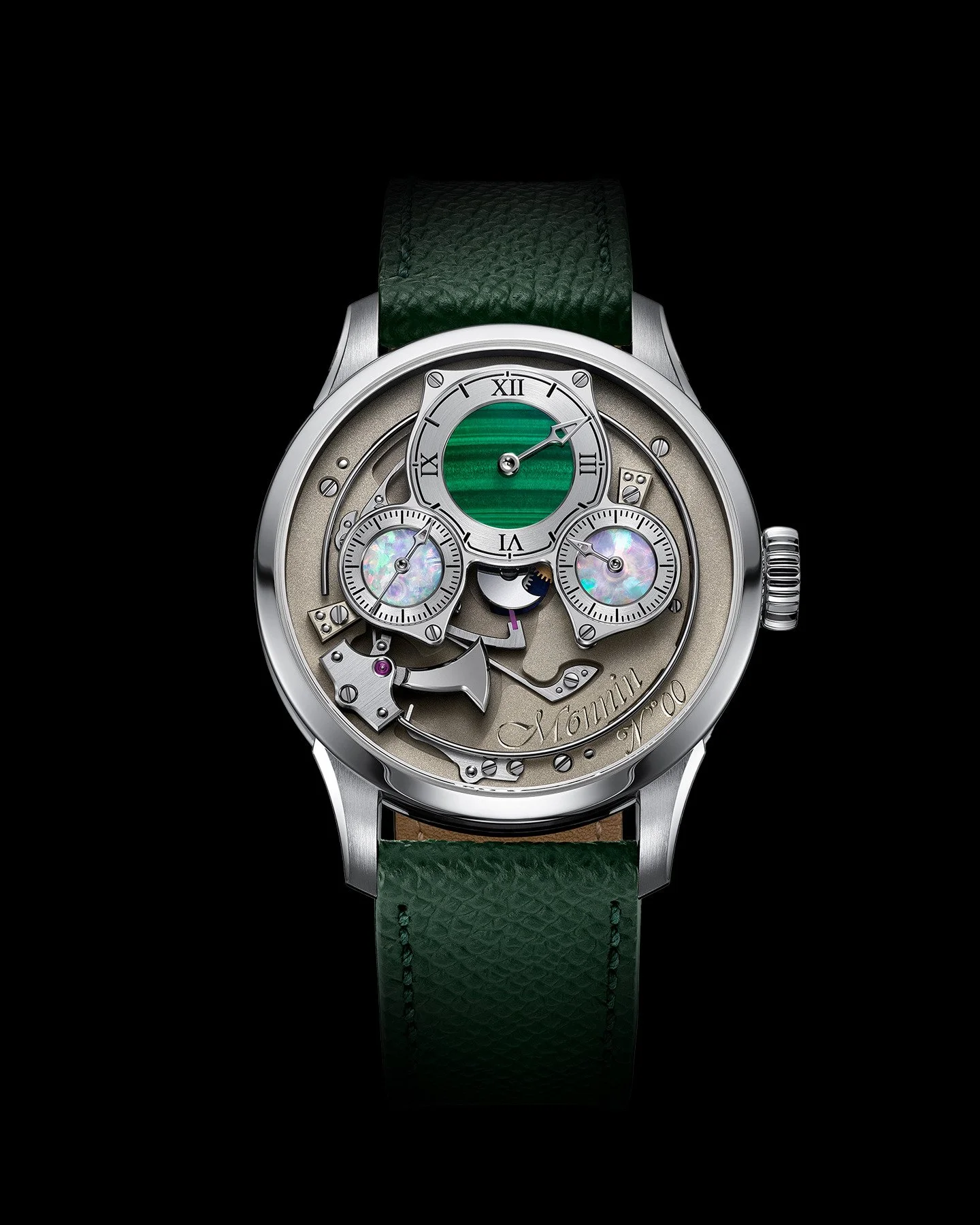
Hazemann & Monnin’s rise is emblematic of that shift. Founded by Alexandre Hazemann and Victor Monnin, the atelier has methodically built its capabilities from the ground up—design, prototyping, machining, finishing, and assembly—prioritizing autonomy in an industry often defined by fragmentation. Their debut creation, the School Watch, is less a product than a manifesto: a piece that merges technical complexity—an instantaneous jumping hour and passing chime—with distinct aesthetic duality.
Hazemann’s interpretation leans toward mechanical expression, punctuated by sharp blue accents, while Monnin’s version explores material storytelling through natural stone dials like malachite and opal. Together, they articulate a shared philosophy: that timepieces should invite not just observation, but contemplation.
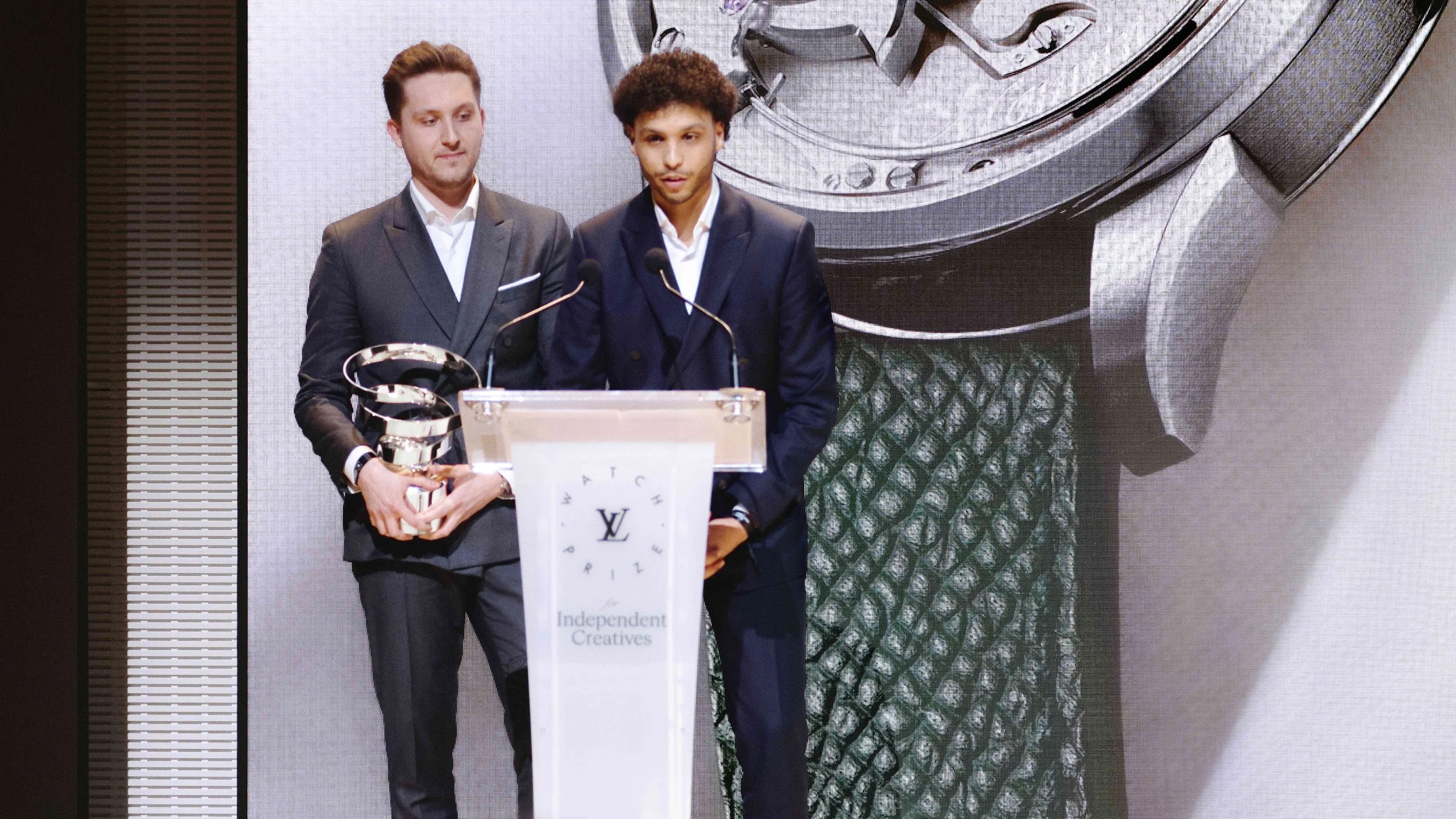
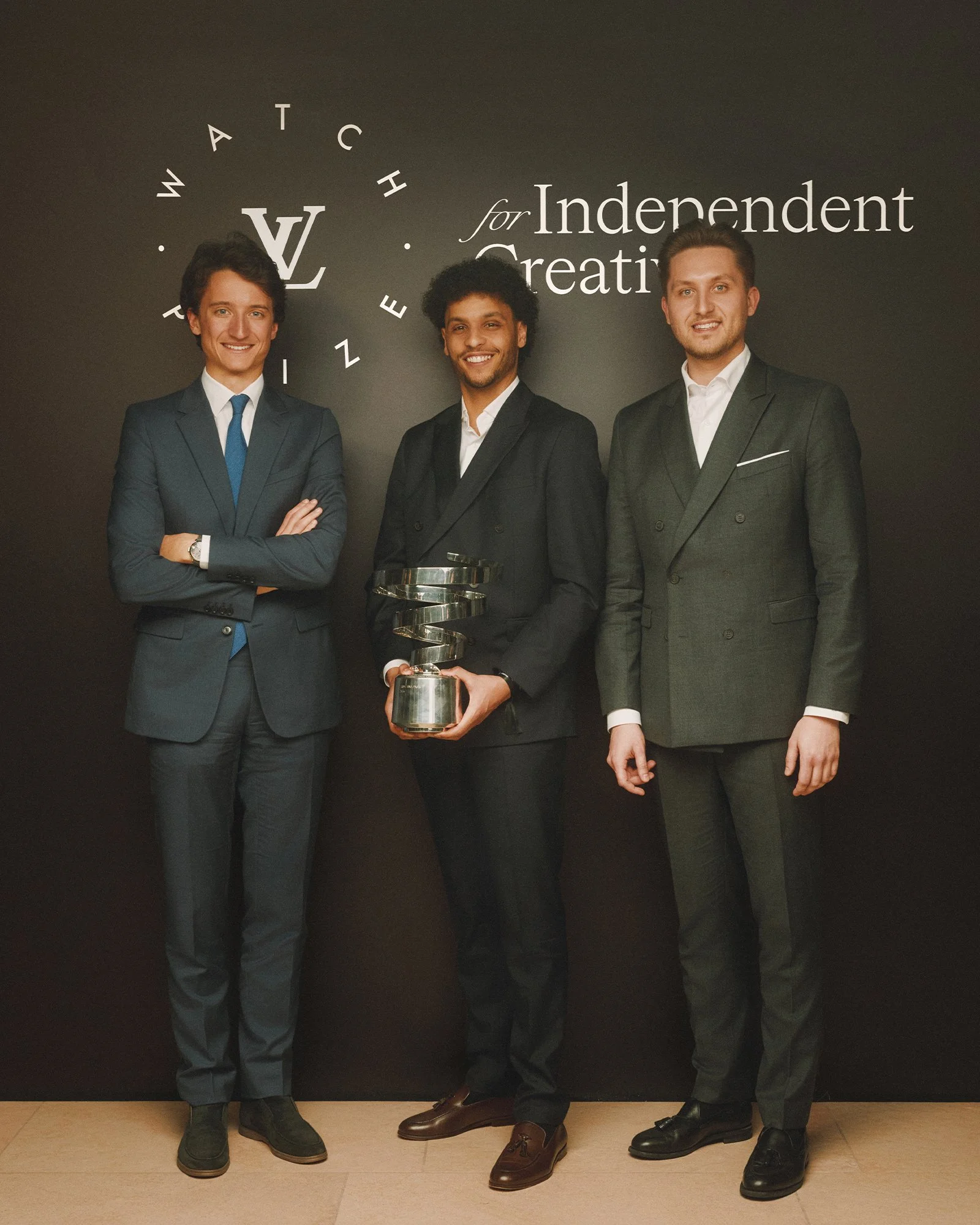
Alexandre Hazemann and Victor Monnin
“Winning the Prize affirms an approach we believe in,” the founders noted, underscoring how recognition at this level is as much about validation as it is about acceleration. That acceleration comes in tangible form—a €150,000 grant and a year-long mentorship with La Fabrique du Temps Louis Vuitton—but also through access to an ecosystem that few independents can tap into alone.
Since its launch in 2022 under the vision of Jean Arnault, the Prize has evolved into something more expansive than a biennial accolade. It has become a platform that decentralizes watchmaking excellence, recognizing talent irrespective of geography or tenure. This year’s finalists—from China to Japan to Switzerland—demonstrate a recalibration of where innovation can originate, and how it’s defined.
What distinguishes the Louis Vuitton Watch Prize is its deliberate distance from corporate influence in the selection process. The winner is determined entirely by an independent jury, including industry figures like Carole Forestier-Kasapi and Kari Voutilainen, ensuring that credibility remains anchored in peer recognition rather than brand alignment.

And yet, Louis Vuitton’s role as facilitator is unmistakable. Through initiatives like this, the House extends its historical commitment to craftsmanship—dating back to its origins in travel trunks—into a contemporary dialogue about what luxury means today. Increasingly, that definition hinges less on scale and more on authorship, less on legacy alone and more on the courage to reinterpret it.
In that context, the spiral-shaped trophy awarded to Hazemann & Monnin feels particularly apt. Inspired by the balance wheel, it symbolizes both precision and perpetual motion—a fitting metaphor for an industry in evolution.
For independent watchmakers, the message is clear: the future of horology won’t be dictated solely by legacy maisons, but co-authored by a new generation willing to challenge, refine, and ultimately redefine the craft.





HOW DO YOU FEEL ABOUT FASHION?
COMMENT OR TAKE OUR PAGE READER SURVEY
Featured





Digital rewards strengthen luxury through practical service, selective access, and thoughtful personalization that keeps each purchase valuable for longer.