
Off-White Rewrites Its Own Code With “10x10: Icons Reimagined”
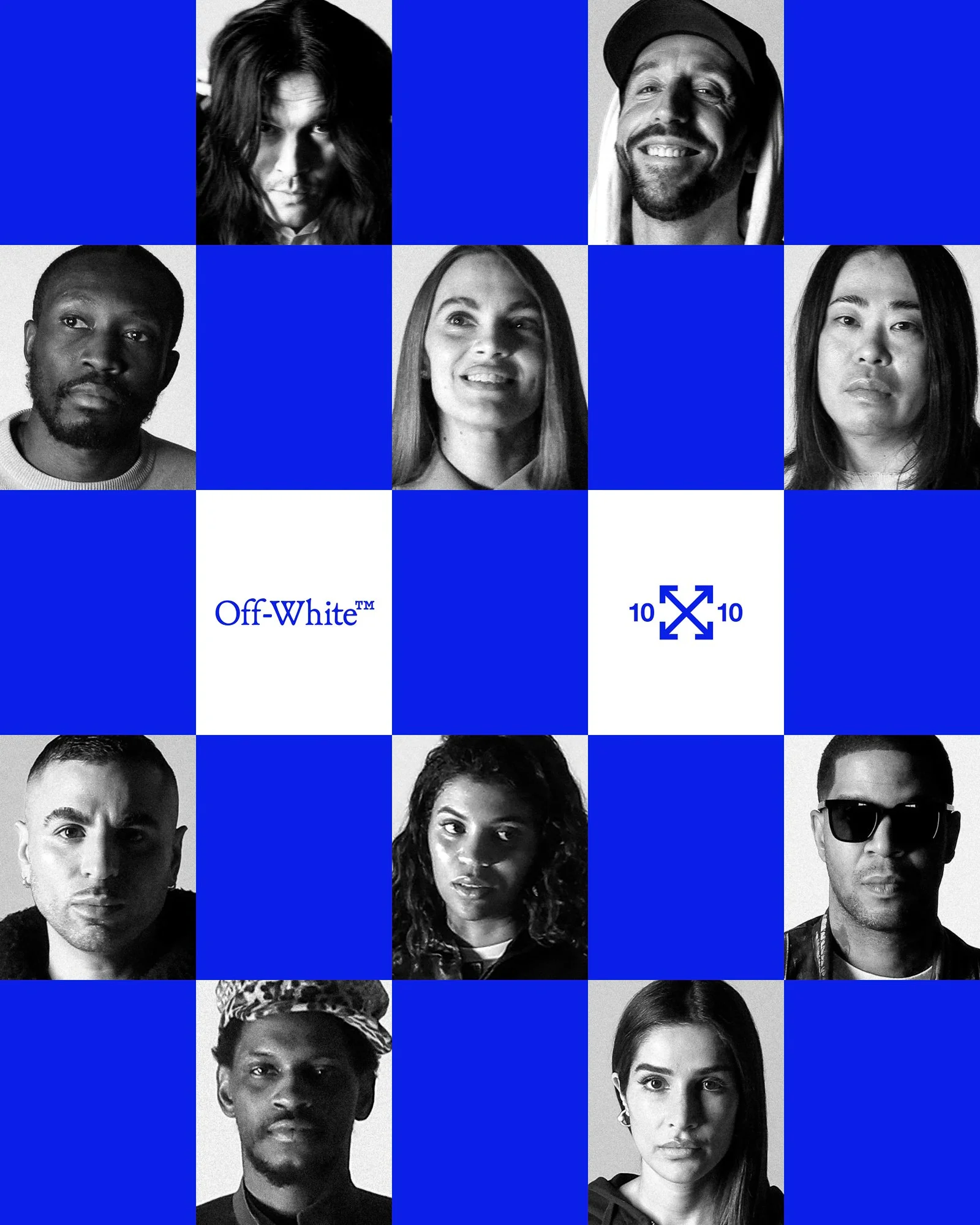
Image: Off-White™
By PAGE Editor
In fashion, legacy is often treated as something to be preserved. At Off-White, it’s something to be continuously rewritten.
With “10x10: Off-White™ Icons Reimagined,” the Milan-based label introduces a new chapter in its post-Virgil Abloh era—one that resists nostalgia in favor of iteration. The premise is deceptively simple: ten of the brand’s most recognizable icons are handed over as blank canvases to ten global creatives. The result is less a retrospective than a living system—one that reflects Abloh’s enduring question: What’s the hack?
Rather than enshrine the past, 10x10 treats Off-White’s archive as source code—open, mutable, and primed for reinterpretation. It’s a strategic continuation of the brand’s “Question Everything” ethos, positioning Off-White not just as a fashion house, but as a cultural operating system where authorship is shared and constantly evolving.
The chosen collaborators underscore that intent. Artists like Kid Cudi and A$AP Nast sit alongside designers including Raul Lopez, Ava Nirui, and Yuta Hosokawa, as well as multidisciplinary voices such as Renell Medrano and Veneda Carter. Each participant brings an existing relationship with the brand—an important qualifier that ensures familiarity with its visual language, but also the confidence to disrupt it.
This balance between fluency and friction is where the project finds its edge.
Take the everyday T-shirt, reimagined by Ava Nirui. Her interpretation leans into gender-agnostic design and ’90s cultural nostalgia, reframing the garment as a communal artifact rather than a commodity. Meanwhile, Lopez’s take on the Jitney bag threads together diasporic narratives, merging New York and Dominican influences into a single object that speaks to both heritage and futurity.
Elsewhere, Hosokawa transforms the hoodie into a vehicle for communication—less about comfort, more about coded messaging—while Medrano’s eyewear becomes an extension of her photographic lens, blurring the line between observer and participant. Even the more abstract contributions, like Bafic’s “Fine Print,” challenge conventional notions of product, favoring process-driven storytelling over static design.
What emerges is not a collection in the traditional sense, but a decentralized narrative. Each piece exists as a node within a broader cultural dialogue—one that spans fashion, music, art, and architecture.
This is where Off-White’s positioning becomes particularly instructive. Under the stewardship of Bluestar Alliance, the brand has leaned into scalability without abandoning its experimental core. 10x10 reflects a broader industry shift: heritage brands are no longer defined solely by what they produce, but by the ecosystems they cultivate.
The global rollout—spanning from May 2026 through April 2027—reinforces that idea. Rather than a singular runway moment, Off-White is opting for a distributed series of activations, allowing each reinterpretation to unfold within its own cultural context. It’s a strategy that mirrors the decentralized nature of contemporary influence, where meaning is constructed across geographies and communities rather than dictated from a single center.
If Abloh’s original vision was about defining the “grey area,” 10x10 expands that space indefinitely. It suggests that icons are only as powerful as their ability to be reimagined—and that true cultural relevance lies not in preservation, but in participation.
In that sense, Off-White isn’t just revisiting its icons. It’s stress-testing them.
The “Collab”:
1. T-SHIRTS — Ava Nirui
Reframes the everyday Off-White™ uniform through a gender-agnostic lens, infused with ’90s youth culture nostalgia and community-driven storytelling.
2. BAGS (Jitney) — Raul Lopez
Transforms the Jitney bag by blending New York and Dominican cultural narratives, emphasizing heritage as a driver of future design.
3. WOMENSWEAR — Veneda Carter
Reinterprets the “METEOR” motif into a bold visual signature, merging experimental styling with Off-White™’s graphic language.
4. SNEAKERS — Kid Cudi
Returns the silhouette to its sport roots while positioning the sneaker as both product and artistic platform—grounded in freedom of expression.
5. VARSITY JACKET — Stéphane Ashpool
Channels a personal history with Virgil Abloh into a playful yet referential take on the varsity jacket, merging heritage motifs with Parisian street culture.
6. HOODIES — Yuta Hosokawa
Reimagines the hoodie as a communication tool, drawing from his signature deconstructed, upcycled aesthetic.
7. DENIM — Guillermo Andrade
Explores denim through the lens of Virgil as muse—blending personal narrative with technical craftsmanship and streetwear codes.
8. EYEWEAR — Renell Medrano
Applies a photographic perspective to eyewear design, reframing Off-White™ aesthetics through her distinct visual language.
9. FINE PRINT — Bafic
Evolves Off-White™’s graphic language into a process-driven visual diary, prioritizing accumulation and experimentation over final form.
10. OBJECTS — A$AP Nast
Pays tribute to Virgil Abloh’s omnipresence and generosity through conceptual objects that blur time, function, and cultural connectivity.
HOW DO YOU FEEL ABOUT FASHION?
COMMENT OR TAKE OUR PAGE READER SURVEY
Featured




Celebrating its 10th anniversary, Brooklyn-based FABSCRAP is demonstrating how textile recycling, material reuse, and a community of more than 11,000 participants can help fashion move toward a more circular future.