
The Science Behind Personal Color Analysis: Why Certain Colors Make You Look Better
PAGE
By PAGE Editor
Have you ever worn an outfit that looked stunning on the hanger but somehow felt wrong once you put it on?
Maybe the fit was perfect and the style was trendy, yet something about the overall look felt dull or unbalanced. Your skin looked tired, your eyes didn’t stand out, and the color seemed louder than you.
This happens to many people, and it rarely has anything to do with body shape or fashion sense. In most cases, the real reason is color.
Personal color analysis is the practice of identifying the colors that naturally complement your skin tone, hair color, and contrast levels. When the right shades are worn, the result is immediate. Skin appears brighter, features look clearer, and the entire outfit feels more harmonious.
Understanding the science behind personal color analysis can transform the way you shop, dress, and build your wardrobe.
Why Color Matters More Than Most People Realize
In fashion, color is not just decoration. It directly affects how the human eye perceives your face.
The skin reflects surrounding colors. If the color near your face harmonizes with your natural undertone and contrast, your complexion appears balanced and healthy. If the color clashes, the opposite happens.
This is why two people wearing the same dress can look completely different. On one person, the color appears vibrant and flattering. On another, it may highlight shadows, uneven skin tone, or fatigue.
Professional stylists often say that color should support your features rather than compete with them. When the color palette aligns with your natural coloring, people notice you first instead of the clothing.
The Three Foundations of Personal Color Analysis
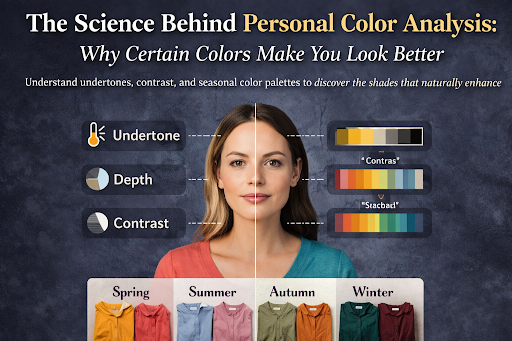
Color analysis is not random. It is based on three key elements that determine which shades work best for an individual.
These elements are undertone, depth, and contrast.
1. Undertone: The Temperature of Your Skin
Undertone refers to the subtle temperature beneath the surface of your skin.
It typically falls into three categories.
Warm undertones contain golden, peach, or yellow hues.
Cool undertones contain pink, red, or bluish tones.
Neutral undertones balance both warm and cool elements.
Undertone plays a critical role in determining which colors look harmonious near your face. For example, warm skin tones tend to glow in earthy colors such as coral, mustard, olive, and warm reds. Cool undertones often look more balanced in jewel tones like sapphire blue, berry shades, and blue-based reds.
Understanding your undertone allows you to eliminate a large number of unflattering shades immediately.
If you are unsure how to identify your undertone, a detailed explanation of undertones and seasonal palettes can help you start narrowing down your ideal color range. Resources such as the guides available on Style By Shades explain how undertones influence clothing choices and personal color palettes.
2. Depth: How Light or Dark Your Overall Coloring Is?
Depth refers to the overall lightness or darkness of your natural features.
It is determined by the combination of your hair color, eye color, and skin tone. Someone with dark hair and deep eyes typically has a deeper coloring, while someone with light hair and fair skin may fall into a lighter category.
Depth influences how intense a color should be to look balanced.
For example, someone with deeper coloring often looks stronger in saturated shades such as burgundy, emerald, or cobalt blue. Meanwhile, people with lighter coloring usually look better in softer tones like dusty rose, light blue, or pastel shades.
When depth is ignored, the color can either overpower the person or fade into the background.
3. Contrast: The Difference Between Your Features
Contrast refers to the visual difference between your hair, skin, and eyes.
High contrast occurs when there is a strong difference between features. For example, dark hair paired with light skin creates noticeable contrast. These individuals often look striking in bold combinations such as black and white or deep jewel tones.
Low contrast occurs when features are similar in depth. Blonde hair, light skin, and light eyes create a softer contrast level. These individuals often look best in blended color combinations rather than dramatic contrasts.
Matching the contrast of your outfit with the natural contrast of your features creates visual harmony. This is one of the most overlooked principles in everyday styling.
The Role of Seasonal Color Palettes
Many stylists organize personal color analysis into seasonal palettes. The most common framework divides color types into four main groups: Spring, Summer, Autumn, and Winter.
Each season represents a combination of undertone, depth, and contrast.
Spring palettes typically feature warm and bright colors.
Summer palettes contain cooler, softer tones.
Autumn palettes emphasize warm, rich, earthy shades.
Winter palettes are defined by cool, bold, high-contrast colors.
These seasonal systems help simplify color selection. Instead of choosing from thousands of colors, you focus on a curated palette that naturally complements your features.
Many people discover that once they understand their season, shopping becomes much easier. The guesswork disappears, and clothing begins to coordinate more naturally.
For readers who want to explore seasonal palettes further, guides such as those on Style By Shades break down the differences between color seasons and explain how to identify your personal palette.
Why Wearing the Right Colors Changes Your Appearance?
The right colors influence the way light reflects onto your skin. When the tone is harmonious, it reduces visual shadows and enhances natural brightness.
Several subtle improvements often occur at the same time.
Skin appears clearer and more even.
Eyes appear brighter and more defined.
Dark circles appear less noticeable.
Makeup becomes easier to apply.
These changes can create the impression that someone looks more rested or confident, even if nothing else about their outfit has changed.
In contrast, wearing the wrong colors can emphasize uneven skin tone, highlight redness, or create shadows under the eyes.
This is why personal color analysis is often described as one of the most powerful yet underrated tools in personal styling.
How Global Fashion Is Shifting Toward Personalized Color?
Fashion used to revolve around seasonal trends dictated by designers and fashion houses. Today, consumers are becoming more aware that not every trend works for every person.
The rise of personal styling, digital fashion tools, and online color analysis resources has shifted the focus toward individualized wardrobes.
Instead of chasing every new color trend, many people are learning to identify which shades truly suit them. This shift reflects a broader movement toward intentional fashion.
Rather than owning dozens of random items, people are building wardrobes that feel cohesive and flattering. Colors repeat across outfits, making clothing easier to mix and match.
From a sustainability perspective, this approach also reduces unnecessary shopping and waste.
How to Start Discovering Your Best Colors?
You do not need professional styling services to begin exploring your best color palette.
Start by observing how different colors affect your face in natural light.
Hold garments near your face and notice whether your skin looks brighter or duller. Pay attention to whether your eyes appear clearer or less defined.
Taking simple photos with different colored tops can also reveal patterns. Over time, you will notice which tones consistently enhance your appearance.
Another helpful approach is building a small collection of neutral colors that work well together. Once those foundations are established, adding accent colors becomes much easier.
The Future of Personal Color Analysis
As fashion continues to evolve, personalization is becoming more important than ever.
Technology is beginning to integrate color analysis tools into online shopping experiences. Artificial intelligence and digital styling platforms are helping consumers experiment with colors before making purchases.
At the same time, traditional styling knowledge remains incredibly valuable. Understanding undertones, contrast, and seasonal palettes allows people to make better decisions regardless of trends.
The ultimate goal of personal color analysis is not to limit creativity but to guide it. When you know which colors work best for you, fashion becomes less about guessing and more about expressing your identity with confidence.
Final Thoughts
The science behind personal color analysis explains why certain shades can transform your appearance while others fall flat.
By understanding undertone, depth, and contrast, anyone can begin identifying colors that enhance their natural features. Once those colors become the foundation of a wardrobe, getting dressed becomes simpler, more intentional, and far more satisfying.
Fashion trends will always change, but the principles of color harmony remain constant. When clothing colors work with your natural features rather than against them, style feels effortless.
And often, the difference between an outfit that looks ordinary and one that looks extraordinary is simply the color you choose.
HOW DO YOU FEEL ABOUT FASHION?
COMMENT OR TAKE OUR PAGE READER SURVEY
Featured

The luxury outerwear house Moncler revisits its alpine heritage through three generations of cultural icons, reframing archival designs as expressions of personal identity, creative evolution and enduring influence.