
Does Machine Embroidery Damage Leather More Than Hand Embroidery?
PAGE
By PAGE Editor
Embellishing leather by means of embroidery requires a high degree of accuracy, patience, and knowledge concerning how the fabric behaves when stitched upon. If you are decorating a premium leather jacket, embroidering a biker's vest, or designing your own pair of gloves, one thing will certainly cross your mind, does machine embroidery destroy leather more compared to hand embroidery? Well, the simple answer is – it depends. But there is much more to this statement than meets the eye.
Reason for the Unique Reaction of Leather to Embroidery
While fabrics like cotton and denim have a woven structure, leather is a non-woven material, which is dense and quite rigid. Any prick from an embroidery needle leaves a permanent hole in the leather. Unlike the self-healing nature of cotton and denim, the leather material cannot heal itself once punctured.
Machine Embroidery on Leather: The Potential Dangers
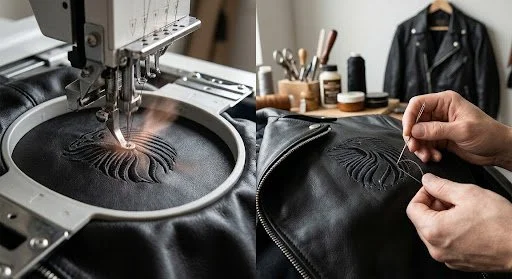
Machine embroidery employs needle motions that occur automatically and rapidly, allowing up to hundreds of stitches per minute. In leather, there are certain dangers associated with these motions.
1. Dense Sewing
Typically, most machine embroidery patterns are designed for fabrics rather than leather. Using the design on leather without adjusting its density causes damage to the leather fibers, leading to cracks in the stitching area, as well as tearing if the item is moved or worn.
2. Heat and Friction
When sewing at a high rate using machine needles, friction heat is produced. When this occurs on leather, the leather gets scorched and changes color, particularly on softer leather varieties.
3. Need for a Stabilizer
For machine embroidery on leather to be effective, it requires a stabilizer to keep the leather still throughout the process. If the leather moves during the process, it will permanently alter the leather's appearance.
Machine vs. Hand Embroidery: Leather Damage Comparison
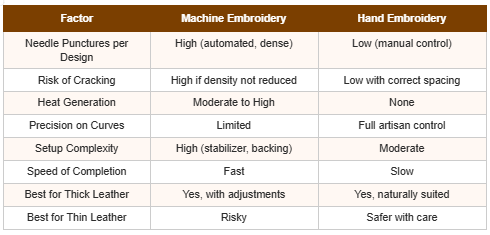
Hand Embroidery on Leather: An Easier Method to Handle
When doing hand embroidery, the artisan gets to control every puncture and stitch. No heat is involved as one moves along and can feel how the leather resists while adjusting his/her pressure accordingly. The feedback provided by hand embroidery makes it less harmful to the leather, especially if it is delicate.
However, when done wrongly, hand embroidery can pose dangers. It may involve using a different needle size, having lines that are too close together, and even pulling the threads too tightly.
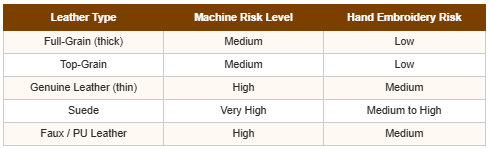
Damage Risk by Leather Type
Important Factors That Actually Influence the Likelihood of Damage
Just the embroidery technique does not determine whether your leather will be damaged. These factors have the same importance:
Needle size – A needle that is too thick leaves bigger holes than needed. Needles that are sharp and thin, such as 75/11 or 90/14, are recommended for leather in both cases.
Tension – High tension draws the leather surface inside, resulting in a lasting deformation called puckering. Tension should be balanced in both machine and hand embroidery.
Complexity of the design – Dense fill stitching is much more damaging to leather than outline stitching. You should simplify the design at all costs.
Backing and stabilizer – In machine embroidery, use cutaway stabilizers to absorb the impact. In hand embroidery, use adhesive backing to hold the material.
Full-grain and top-grain are the most common choices for a Leather Jacket Black, and both respond well to hand embroidery when handled correctly.
Which Embroidery Technique Is Really More Safe for Leather?
Given the experience of the industry and the specifics of materials, hand embroidery seems to be more safe than machine one for thin, delicate or valuable leather items. Still, machine technique performed by an experienced specialist using specific settings of a machine adjusted for leather and its characteristics can provide good results without damage.
It is not the machine or the hand that causes damage. It is the wrong implementation of any technique by inexperienced people.
Expert Tips to Avoid Damaging Leather While Embroidering
Use a special leather needle instead of a regular embroidery needle.
Decrease stitch spacing by 30 to 40 percent in comparison with conventional fabric patterns if you are embroidering on a machine.
Make small holes in the leather beforehand with a leather needle if you are doing hand embroidery.
Test your pattern on a leather sample first before moving on to your actual work.
Condition your leather before embroidering to make the fabric more flexible and avoid cracks.
Final Conclusion
Although machine embroidery presents a higher level of inherent risk for leather damage based on speed, heat generation, and stitch density, it can be completely controlled using the proper techniques and preparation process. Hand embroidery is easier and more effective for fragile or irregular leather items. Regardless of whether you opt for machine or hand embroidery, an appreciation of the leather's structure will determine the longevity of your work.
FAQs
1. Which is better – hand embroidery or machine embroidery on leather?
For leather, the answer is simple – hand embroidery. It will provide more control and no heat whatsoever. Machine embroidery is quick, but it needs proper setting up so that it does not to crack or burn the material.
2. Can machine embroidery crack the leather after some period of time?
Yes, it can. The reason for that is very dense stitches combined with the friction heat of a fast-moving needle, causing weakening of the fiber of the leather. If the pattern is designed properly for leather work, there should be no problem.
3. What needle should I use for embroidery on leather?
Use only leather needles, please. Size 75/11 or 90/14 sharp needle will produce clean small holes.
4. Is hand embroidery as durable as machine embroidery when used on leather products?
With correct handling, hand embroidery is highly durable and will exceed the durability of machine embroidery on leather.
5. Is suede leather safe for embroidery?
Suede leather is the most dangerous material to work with in terms of embroidery. The leather is delicate and soft; machine embroidery should be avoided on this material completely. Only pre-holed hand embroidery is considered safe.
HOW DO YOU FEEL ABOUT FASHION?
COMMENT OR TAKE OUR PAGE READER SURVEY
Featured




Digital rewards strengthen luxury through practical service, selective access, and thoughtful personalization that keeps each purchase valuable for longer.