
Rethinking First Frame Quality Through Nano Banana Pro
PAGE
By PAGE Editor
In the rapidly shifting landscape of generative video, there is a persistent misconception that the video model is the sole arbiter of the final output’s quality. While the underlying architecture of a model like Nano Banana Pro is undoubtedly powerful, experienced creators understand a fundamental truth: the video is only as good as the static frame that birthed it. In an "image-to-video" workflow, the source asset acts as the DNA for every subsequent frame. If that DNA is corrupted by low resolution, poor composition, or lighting inconsistencies, the downstream temporal artifacts become unavoidable.
The transition from static generation to fluid motion is not a simple translation; it is an interpretation. When using Nano Banana Pro, the system analyzes the spatial relationships within your starting image to predict how those elements should behave over time. This makes the initial curation of your "Frame 0" the most critical step in the entire production pipeline. It is no longer enough to generate a "cool" image; you must generate a technically sound foundation.
The Technical Reality of Temporal Consistency
Temporal consistency refers to the AI’s ability to maintain the appearance of objects, textures, and lighting as they move through time. When a video "flickers" or "morphs" into something unrecognizable, it is often because the model struggled to understand the geometry of the source image. High-quality assets provided to Nano Banana Pro AI reduce this cognitive load on the model.
Consider the complexity of a human face or a highly detailed mechanical object. If the initial image contains "AI hallucinations"—such as an extra finger or a distorted eye—the video model will attempt to resolve these errors in motion. This usually results in a disturbing warping effect as the AI tries to make sense of anatomically impossible structures. By ensuring the source image is polished and anatomically correct using tools like the Kimg AI editor, you provide a clear roadmap for the motion algorithms to follow.
Why Composition Dictates Motion Paths
Composition is often discussed in terms of aesthetics, but in generative video, composition is a blueprint for physics. The placement of a subject in relation to the background tells the model how to handle parallax and depth. A subject placed too close to the edge of the frame often results in "clipping" issues, where the AI doesn't have enough surrounding pixel data to fill in the gaps as the camera pans or the subject moves.
When working with Nano Banana Pro, center-weighted or Rule of Thirds compositions tend to yield the most stable results for beginners. However, more advanced creators are finding that "leading lines" within a static image can actually guide the AI’s motion. If a road in your image recedes into the distance, the model is more likely to interpret a "dolly-in" motion correctly. Conversely, a flat, two-dimensional composition provides very little depth data, often leading to a "Puppet Warp" look where the image feels like a flat plane being stretched rather than a 3D space being explored.
The Critical Role of Resolution and Density
Resolution is more than just a numbers game. It is about pixel density and the information the model has to work with. If you start with a 512x512 image and try to generate a high-definition video, the AI has to "invent" a massive amount of detail. This invention process is where noise and artifacts are born.
Using the upscaling features available on Kimg AI to bring an image to "K level" resolution before sending it to the video generator is a standard operating procedure for professional-grade results. Nano Banana Pro AI performs significantly better when it doesn't have to guess the texture of a fabric or the glint on a glass surface. When the source image is crisp, the motion appears more intentional and less like a series of blurred transitions.
Moment of Limitation: The Resolution Ceiling
It is important to acknowledge a current technical reality: upscaling a source image to 4K or 8K does not automatically guarantee a 4K video output. Most current video models, including those in the Nano Banana Pro family, operate on specific internal latent dimensions. While a high-resolution input provides better "guidance," the model may still downsample that image during the initial processing phase. The benefit of high-quality input is less about the final pixel count and more about the clarity of the features that the model identifies for tracking.
Texture Retention and Lighting Integrity
One of the most difficult things for AI to maintain is consistent lighting across a sequence. If your starting frame has conflicting light sources or "muddy" shadows, Nano Banana Pro may struggle to keep the lighting stable as the camera moves. This results in "strobing," where the brightness of the scene fluctuates rapidly.
To combat this, creators should prioritize images with high dynamic range and clear directional lighting. When the AI can clearly identify where the light is coming from, it can calculate how shadows should shift as objects rotate. Nano Banana Pro AI is particularly adept at handling reflections and metallic surfaces, provided those surfaces are clearly defined in the source asset. A blurry, low-contrast image of a chrome car will almost always lead to a video where the car appears to be melting.
Workflow Integration on Kimg AI
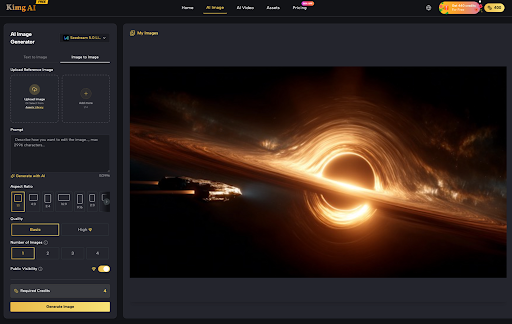
The Kimg AI platform is designed to facilitate this "Asset First" mindset. Instead of jumping straight to video, the workflow encourages a multi-step refinement process.
Generation: Start with Nano Banana or Flux to create the core concept.
Inpainting and Editing: Use the Kimg AI editor to remove any anatomical errors or distracting background elements that might confuse the motion model.
Upscaling: Use the "K Level" upscaler to ensure the pixel density is sufficient for the video model to track textures accurately.
Video Synthesis: Finally, pass the refined asset to Nano Banana Pro.
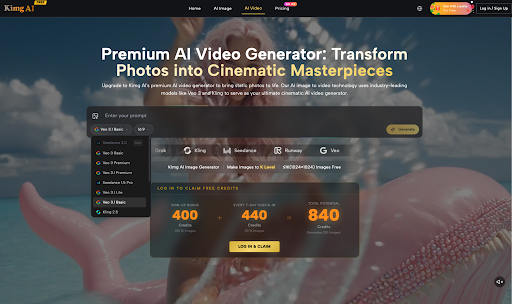
This structured approach minimizes the trial-and-error often associated with AI video. By spending five extra minutes refining the static image, you can save hours of wasted credits on failed video renders. The platform's 400-credit sign-up bonus provides enough headroom for this iterative process, allowing users to test how different levels of image polish affect the final video stability.
The Illusion of Control and the "Black Box" Problem
Despite our best efforts in preparation, we must remain realistic about the current state of the technology. AI video generation still contains a significant element of entropy. Even with a perfect source image, the model's interpretation of motion is a probabilistic outcome.
Moment of Uncertainty: Motion Interpretations
Even when using a sophisticated model like Nano Banana Pro AI, there are times when the system ignores clear visual cues. For example, you might provide a high-resolution image of a bird with its wings spread, expecting a flight sequence, only for the AI to decide the bird should remain stationary while the background moves. This "black box" nature of AI motion means that while we can optimize the input, we cannot yet perfectly dictate every frame of the output. Expectation management is key; the goal of high-quality source assets is to increase the probability of a good result, not to guarantee a specific cinematic masterpiece on the first try.
Practical Judgment for Creators
For indie makers and prompt-first creators, the shift from "typing a prompt" to "curating an asset" is the hallmark of growth. Relying solely on text-to-video often results in generic, low-detail clips that lack a unique visual signature. By taking control of the first frame, you inject your specific aesthetic into the AI’s process.
When evaluating your source image for Nano Banana Pro, ask yourself:
Are the edges of my subject clearly defined, or do they bleed into the background?
Is the lighting logical and consistent?
Does the composition provide enough "buffer" space for camera movement?
Is the texture high-resolution enough that the AI won't have to guess what it's looking at?
If the answer to any of these is "no," the solution is not to try a different video prompt, but to return to the image generation or editing stage.
Conclusion: The Future of Asset-Driven Video
The future of AI video is not in more complex prompts, but in better-controlled inputs. Models like Nano Banana Pro are becoming increasingly sensitive to the nuances of the source material. This is a net positive for creators, as it allows for a level of intentionality that was previously impossible in generative media.
By treating your first frame as a high-stakes production asset rather than a disposable draft, you unlock the true potential of the Kimg AI toolkit. The quality of the motion, the stability of the textures, and the overall cinematic feel of your projects are all decided before you ever hit the "Generate Video" button. Focus on the foundation, and the motion will follow.
HOW DO YOU FEEL ABOUT FASHION?
COMMENT OR TAKE OUR PAGE READER SURVEY
Featured



Jackets have always been an important part of fashion.