
Luca Faloni’s North American Expansion Is a Study in Italian Restraint — and Strategic Growth
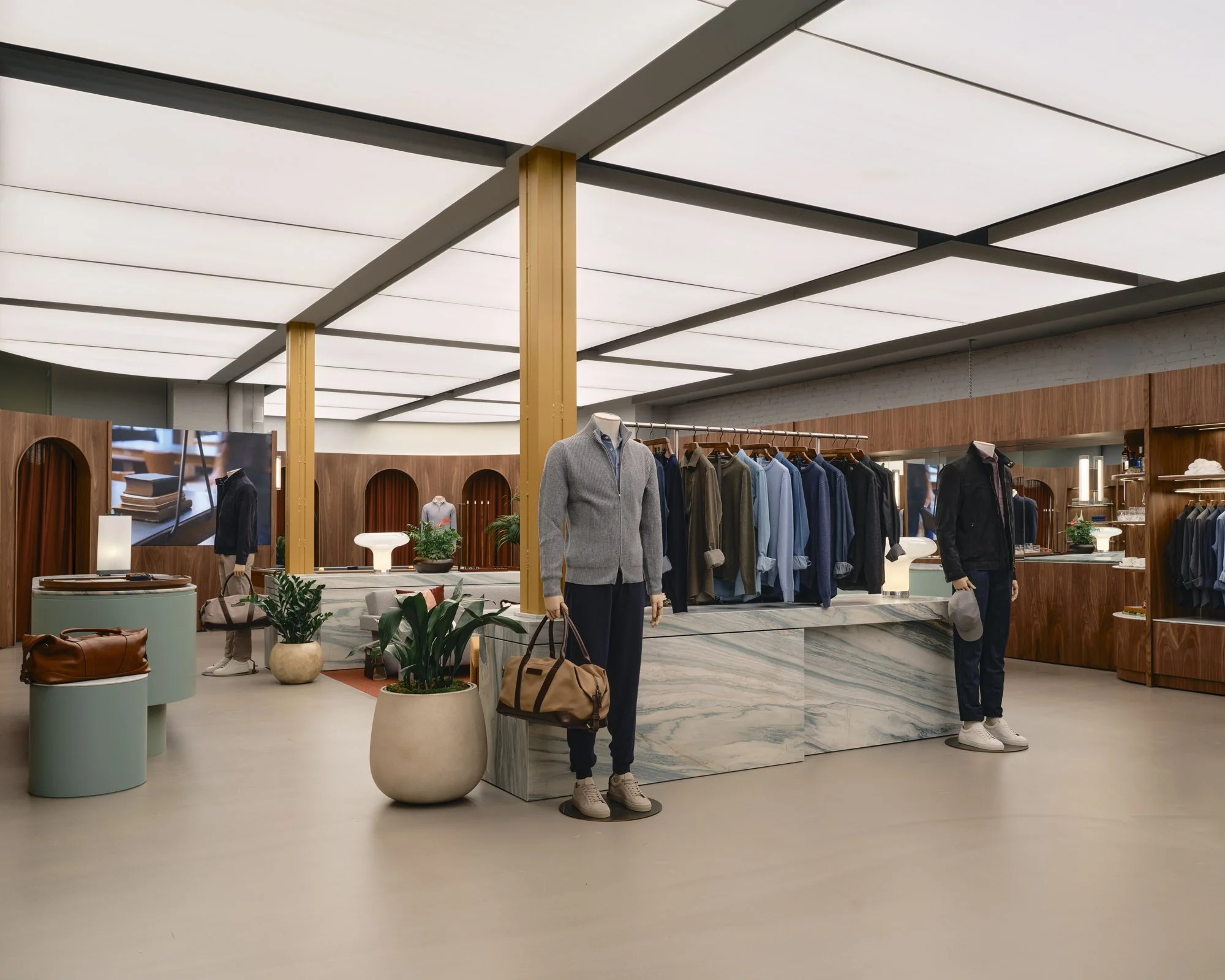
Luxury’s loudest players are chasing virality. Luca Faloni is chasing permanence. The Turin-born founder has quietly built one of menswear’s most disciplined direct-to-consumer brands — rooted in fine Italian craftsmanship, a seasonless design philosophy, and a pastel palette that feels subtle yet unmistakably assured. Now, as the brand deepens its North American footprint, Faloni is doing what he has always done: expanding deliberately.
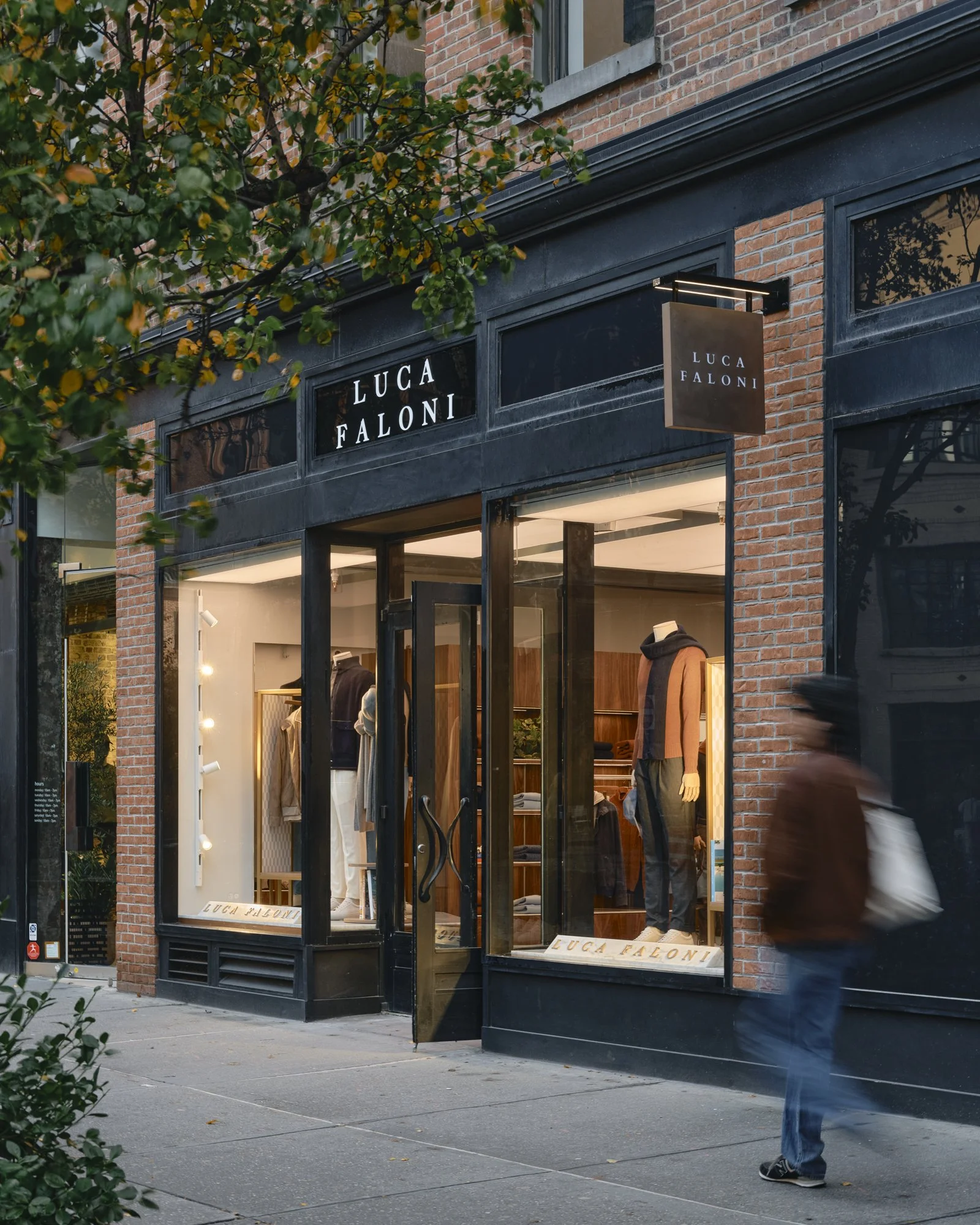
In Fall 2025, the company opened its second New York boutique in Manhattan’s Meatpacking District and debuted its first Canadian flagship on Bloor Street West in Toronto’s Yorkville. Each space is conceived as “Casa Faloni” — less retail store, more refined Italian home. There are aperitivo counters. In New York, a pool table and cinema nook. In Toronto, a dramatic LED wall streaming imagery from the brand’s Italian universe.

But for Faloni, expansion is less about square footage and more about proximity.
“I’m flying to San Francisco tomorrow morning. I’m in London at the moment. We’re looking at a store in Palo Alto that’s gradually materializing. After that, I’ll go to Dallas, then Miami, Palm Beach, and New York. I’ll be in New York on March 2,” he tells me. “Whenever I come to the States, I try to see as many new cities as possible. I’ve never been to Dallas, actually, so I’m curious.”
A Brand Born From Distance
The company’s origin story reads less like a startup pitch and more like an expat’s longing.
“I grew up in Turin. You knew exactly where to buy your shirts, your trousers — the quality was good, and the price was fair. When I moved abroad, I couldn’t find that same combination,” Faloni explains.
In 2012, while living in San Francisco, he recognized an inflection point. “I saw brands like Everlane and Warby Parker starting. It was clear that if you removed the wholesale model, you could offer the same quality for a third of the price. At the same time, Meta was becoming a powerful advertising platform and Shopify made it easy to build an online store. Everything aligned. I thought it was a great opportunity to combine that new business model with Italian craftsmanship.”
The first purchase came in December 2014. “We started the brand about 10 years ago. The first purchase was in December 2014, and our first full year was 2015. We began with a very limited range. The idea was always to gradually develop a total look focused on fine materials.”
Today, the United States accounts for roughly half of the business.
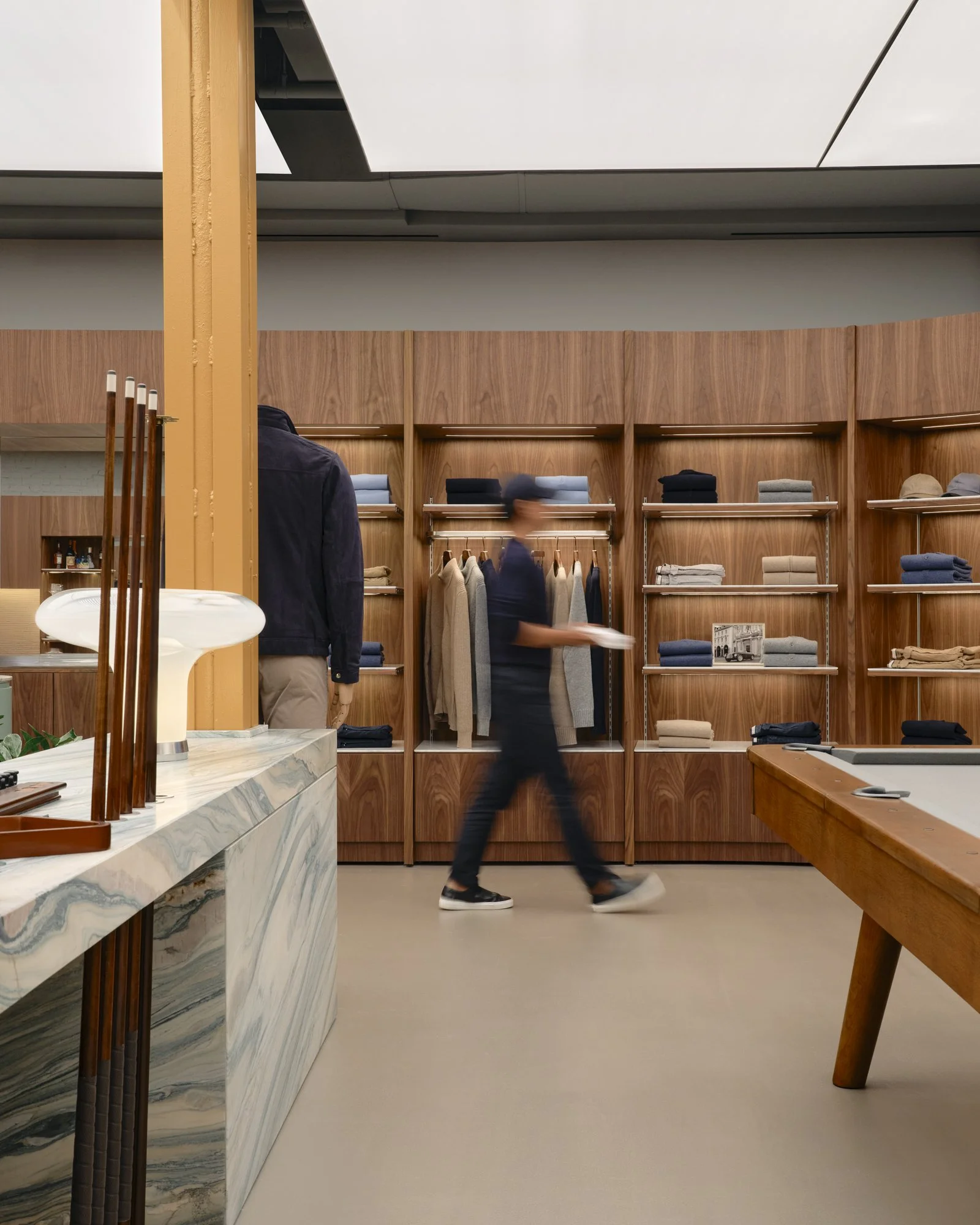
“The United States represents about 40–45% of our online sales. We’re particularly strong in the New York area, the Bay Area, Miami, and Chicago. We just opened in Toronto as well. We want to be present in all the major metropolitan areas in the U.S. to start — and eventually even more. Atlanta, Houston, and later on Los Angeles.”
On Los Angeles, he’s candid: “Los Angeles is slightly more casual in style than our brand, but there’s strong appeal there at the moment.”
Hedging Seasonality, Leaning Into Climate
Retail strategy, for Faloni, is as much about weather as it is about culture.
“In the U.S., we now have two stores in New York — we just opened our second in Meatpacking — and we’ve been in Miami for three years. We’re celebrating our third anniversary there at Brickell City Centre,” he says. “Miami does really well for us. In months like January and February, when other stores are calmer because winter is ending and brands are doing sales, Miami is strong. You have tourists, visitors from South America, and New Yorkers going for the weekend. November through March are some of our strongest months there. It’s a great hedge against seasonality.”
“That’s also why I’m looking at Dallas. I want locations that are warm when our other markets are deep in winter.”
It’s a pragmatic expansion — climate diversification as growth strategy.
Casualization Without Compromise
Faloni’s timing also aligns with a broader recalibration in menswear.
“Even before COVID, wardrobes were becoming more casual. Business owners might wear sneakers today, whereas 15 or 20 years ago they would have worn formal shoes. After COVID, comfort became essential — not just casual, but comfortable for travel and everyday life.”
His answer has been material-led versatility. “Our products sit at the intersection of casual and formal. They’re always made with great materials that feel good, often with a bit of stretch.”
Suits, for example, were a response to demand rather than ambition. “We only introduced suits two or three years ago, starting with linen suits for weddings and summer events — the more enjoyable side of your wardrobe. Later, we added wool suits for winter because customers kept asking. We want to be a one-stop shop.”
Seasonality still defines the core: “In winter, most of our sales are cashmere knitwear. In summer, it’s linen shirts and linen trousers. Linen jersey has been doing incredibly well for us — it’s breathable, soft, more relaxed.”
Trousers now represent nearly a quarter of revenue. “Trousers now account for almost 25% of our revenue. One popular style is a wool pleated trouser with drawstrings — elegant but comfortable.”
Outerwear, meanwhile, anchors store performance. “Outerwear has been particularly important for store revenue. We don’t sell huge volumes, but the price point is higher. We offer leather bombers in goatskin, a racer jacket, a linen bomber for summer, and a city jacket for winter with premium detailing and brushed cotton lining. Outerwear completes the look.”
The Discipline of Refinement
Unlike many contemporary brands chasing reinvention, Faloni prefers iteration.
“Value for money is fundamental. In an industry where prices have increased aggressively, consumers appreciate strong quality at a fair price.”
“Many brands try to reinvent themselves every year. We don’t. We refine. We improve designs gradually based on customer feedback. We focus on luxury staples — foundational pieces that don’t go out of fashion.”
The now-iconic Portofino shirt — known for its one-piece collar and mother-of-pearl buttons — exemplifies this philosophy. “Our linen shirts became extremely popular — especially the Portofino shirt with the one-piece collar and mother-of-pearl buttons. We had 25 colors at one point. Even Prince William wore it.”
Color itself is cultural. “I grew up in Italy, and Italians love pastels. They’re not too bold, not too boring. That’s where we stand — subtle colors that allow personality without being extreme. In summer especially, we embrace color. In winter, the palette is naturally more restrained, but we still try to offer variation.”
Protecting the ‘Made in Italy’ Promise
The through-line remains non-negotiable: manufacturing in Italy.
“All manufacturing is in Italy, and the textiles are made in Italy. Cashmere fiber comes from Inner Mongolia, but the yarn is spun in Italy. Our leather supplier is in Tuscany. Our linen comes from Albini in Lombardy.”
“From day one, the idea was to create the best Made in Italy product and make it accessible worldwide through direct-to-consumer.”
Even future product debates circle back to identity. “We’re currently debating espadrilles. They’re traditionally made in Spain or Portugal, not Italy. We may produce them in Italy anyway, even if it costs more and reduces our margin, because protecting the brand identity matters.”
Growth, With Intimacy
As brick-and-mortar expands, personalization is becoming the next frontier.
“Online, we don’t offer made-to-measure. In-store, we’re becoming more flexible. Customers might want a different color in a specific design, or slight size adjustments. We’re gradually opening up to more personalization.”
“In a competitive world, anything that makes the experience more special and easier for the customer is appreciated. We want to grow that segment.”
Ultimately, Luca Faloni’s North American expansion is not about scale for scale’s sake. It’s about exporting a sensibility — one rooted in fine materials, direct-to-consumer transparency, and a uniquely Italian understanding of hospitality.
In a luxury market increasingly defined by spectacle, Faloni’s approach feels almost radical: refine, don’t reinvent. Protect identity. Expand with intention. And let craftsmanship — not noise — carry the brand forward.
HOW DO YOU FEEL ABOUT FASHION?
COMMENT OR TAKE OUR PAGE READER SURVEY
Featured


BAPE® brings its streetwear legacy into the ring with UNDEFEATED’s wrestling-inspired Fall/Winter 2026 collection while expanding its design vocabulary through the TYPE 10 BAPEX®, an automatic timepiece that translates the brand’s signature camouflage into contemporary watchmaking.