
The Gamification of Luxury: Are Fashion Apps Just High-End Slot Machines?
PAGE
By PAGE Editor
Over centuries, the luxury fashion business worldwide has built its astronomical worth on a foundation of physical exclusivity. The entry barriers were simple: high prices, the physical distance of the elite boutique in Paris, Milan, or New York, and the hushed, threatening atmosphere in the atelier. The field of struggle over luxury has shifted nowadays, though. It is no longer restricted to the wide streets of the world's fashion cities, but on our smartphone screens, which are glossy and bright at 6 inches.
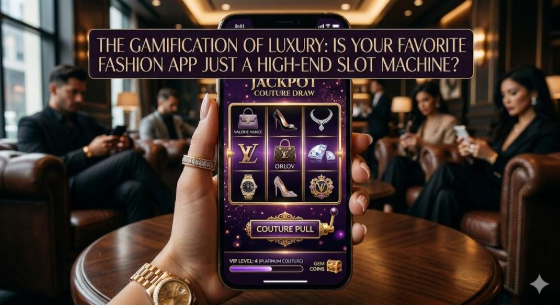
Luxury houses have created an entirely new exclusivity paradigm in this digital migration. It is no longer rooted solely in geographical factors or simple buying capacity; it is rooted in digital luck, algorithmic resistance, and profound psychological indoctrination. Welcome to the gamification of luxury, a multi-billion-dollar business in which the user experience of your preferred luxury fashion app is more and more based on the behavioral conditioning of a Las Vegas casino.
However, as brands increasingly combine drop-in, drop-out, and generated retro-arcade games with essentially the same model into their mobile apps, a question arises: Is the new luxury e-commerce experience a harmless and entertaining upgrade, or a luxury slot machine in disguise?
The Digital Transmutation of Exclusivity
Gamification is a concept that is used to describe the strategic use of game design aspects in non-games to increase the level of user interaction and brand loyalty. Although it was initially adopted in the 2020 pandemic period as a means to add entertainment to the digital catwalk and shop streams, the gamification of luxury retail has quickly developed. It has become an incredibly advanced convergence of behavioral economics, neuropsychology, and hyper-commercialization made specifically for Millennials and Gen Z.
To achieve insights into contemporary luxury e-commerce, one has to look beyond the surface of haute couture and the user experience (UX) design. The common pull-to-refresh gesture of numerous shopping applications is similar to the dopamine-stimulating slot-machine lever. Releasing a drop that is limited has turned into more of a digital gamble, one meant to keep the user glued to their screens all the time, in this state of constant anticipation.
The Architecture of Desire: Behavioral Economics in UX Design
The driving behavioral economics behind gamified luxury applications has to be torn down to deconstruct the efficacy of the latter. The classical school of thought presumes that human beings have rational choices to maximize utility. Behavioral economics is more aware: human actions are strongly affected by cognitive biases, emotions, and shortcuts. Application designers take advantage of all these psychological vulnerabilities to maximize one critical metric: time on device.
Dopamine Loops and Intermittent Variable Rewards
The intermittent variable reward, which is a principle of the design of addictive apps, is based on operant conditioning. By simply clicking a button to enter a digital raffle of a desirable sneaker or by clicking a button to refresh a page to get a flash sale, a user becomes prone to unpredictable results.
Neurological research indicates that the brain reward center discharges dopamine not only when a reward is acquired, butalso when one anticipates the possible reward. Luxury fashion apps are changing the process of shopping into a high-arousal stimulus by eliminating the predictability of a regular purchase. New shiny interfaces, endless scrolling, and constant notifications put the brain in a state of extreme suspense. The emotional state that will be the high of a win, or the reeling depressions of a loss, the psychological reset will instantaneously prepare the user to proceed to the next cycle. The brain has now been rewired to desire the hunt, but not the actual acquisition.
Positive Reinforcement and Loss Aversion
Gamified platforms systematically manipulate consumer habits through two potent levers:
Positive Reinforcement: Long-term platform loyalty is created through the use of points systems, achievement badges, and tiered loyalty rankings. Statistics indicate that users who engage in gamified features have longer user session times (more than 20 minutes) and have a higher purchase rate.
Loss Aversion: Psychological pain from the loss of an asset is twice as intense as the feeling of pleasure from acquiring one. This is weaponized by luxury apps by decaying loyalty points, time-bound checkout lanes, and leaderboards. Users are motivated by the existential fear of being stripped of their accrued status or failing to get an opportunity by an algorithm.
The Atrophy of System 2 Thinking
The cumulative impact of these high-arousal stimuli is the overriding of the System 2 thinking (slow, logical, analytical) with the System 1 thinking (fast, automatic, emotional). Developing severe urgency and social rivalry, luxury apps reduce the ability of a user to make a reasonable assessment of the utility or financial price of a product. This motivates enormous amounts of transactions, but often ends with post-purchase cognitive dissonance, the great regret of an impulsive, gamified purchase.
Scarcity Marketing and the Psychology of the "Drop"
The gamification of luxury is inseparably connected with the so-called drop culture, which the sportswear and streetwear brands initiated and which the legacy houses, starting with Louis Vuitton and Chanel, now appropriate. A drop is a carefully coordinated dumping of extremely scarce products that aim to sell within a few seconds.
Reactance Theory and FOMO
Scarcity marketing is based on reactance theory: when individuals feel that their freedom of choice is limited, they feel the strong need to reclaim it by obtaining the limited choice. Once a brand reports that there are only 500 units of a handbag in the world, consumers automatically create a hyper-inflated value of this product.
The Fear of Missing Out (FOMO) enhances this. The anxiety of being left out is fanned by watching peers or influencers have a limited-edition item. An online sell-out is shown to millions of people in real time, adding even more cultural value to the product.
The "Near Miss" and the "L Streak"
The brands have computerized the queuing process to deal with the demand in real-time. Physical lines are substituted by algorithmic waiting rooms and randomized digital raffles (The Draw). UI designs of spinning wheels, slowly loading bars, increase adrenaline during a digital draw.
No such importation of casino floor mechanics is perhaps as vile as the near-miss effect. In conventional slots, a jackpot is awarded even when the player is a symbol short of a win. In online raffles of fashion, people often have long streaks of consecutive losses, which is actually an L streak. The rejection screen has a visual design that acts as a psychological near miss, when it makes the user believe that it is only a matter of time before he or she wins and is hooked to the next drop.
The Digital Arcade: Haute Couture Meets Video Games
In addition to transactional gamification, luxury brands are building detailed digital worlds to create an intensive brand narrative. To digitally native consumers, gamification is exactly what they want in terms of interactivity and expressing themselves digitally.
Web3 and the Nostalgia Loop
Fashion brands are evolving into the curation of cultural capital as opposed to selling the actual clothing. In an effort to release the Autumn/Winter 2021 collection, Balenciaga released it through a complete online player game known as Afterworld: The Age of Tomorrow. As an example of how virtual luxury objects can be of enormous desirability, Louis Vuitton collaborated with Riot Games to create in-game virtual items (skins) in League of Legends.
In 2018, Gucci released the app, called Gucci Arcade, to intentionally capitalize on the appeal of nostalgia through the inclusion of 8-bit video games. These proprietary online arcades wall the consumer into a walled garden. Each engagement gives the brand minute data on behavioral triggers and aesthetic inclinations that translate the virtual gameplay seamlessly into e-commerce conversion.
Deceptive Designs: The Ethics of Digital Chance
The unethical application of behavioral economics in retail has provoked a fierce ethical examination due to its extremely lucrative nature. At what point does gamification pass into the coercive manipulation category?
The UX researchers categorize the algorithms behind the slot machine effect as deceptive designs (or "dark patterns" and sludge). These are elements of the user interface that are designed with evil intent to abuse the rational choice. A recent study of the European Union established that 4 out of ten surveyed e-commerce websites had explicit manipulations.
In luxury applications, false design is in the form of:
Artificial Time Pressure: Panic is evoked by fake countdown clocks or faster stock depleting signs (e.g., Only 1 item left in your size!).
Manufactured Social Pressure: Messages such as 200 people are viewing this item now, capitalize on the notions of social proof and intimidate preemptive attacks.
The Sunk Cost Fallacy: The systems give rewards for insignificant actions to accumulate points. After they spend time, the users become psychologically obligated to buy a physical product in order to cash in on the points that they did not plan to spend in the first place.
This nudging algorithm limits user freedom. When exposed to such systems, consumers often complain of increased levels of stress, persistent anxiety, and a sense of helplessness.
The Regulatory Horizon: Are Fashion Apps Gambling?
With luxury fashion apps becoming more and more like the casino business, the world's legislators are starting to take notice. A large portion of the legal precedent is currently being determined in the video game sector as to the so-called loot boxes, consumable in-game items that provide a randomized opportunity to obtain a rare reward. The legal similarities between a gaming loot box and a digital sneaker raffle are literally the same.
To be legally considered gambling, a digital mechanism usually needs a bet, a gamble, and a reward of monetary worth. Luxury brands used to claim that their online rewards did not have a tangible financial dimension. The huge expansion of derivative markets (such as StockX), however, eliminates this defense. Since uncommon digitally issued tokens are frequently exchanged as huge amounts of fiat money, the last legal requirement of gambling is met.
The regulatory landscape is highly fragmented:
The European Union: Going full throttle right to regulation. Loot boxes have been effectively defined in Belgium and the Netherlands as illegal gambling. The Digital Fairness Act under consideration aims at enforcing stringent prohibitions of predatory gamification and dark patterns throughout the EU.
The United Kingdom: Depends on self-regulation in the industry because the Gambling Act demands rewards of direct monetary value.
The United States: Lacks federal regulation, which creates a state-by-state patchwork and dependence on the watch of the FTC on deceptive practices.
The Apex Luxury Counter-Movement: Clienteling vs. Algorithmic Hype
With the development of gamification of the luxury retail to a point of scrutiny, there is a deep strategic divergence taking place at the very highest point of the market. As mass-premium labels are doubling on the slot-machine dynamics of digital drops, the real ultra-luxury houses of heritage are making a measured withdrawal.
The tragedy of gamified drop culture lies in the fact that it democratizes the process of trying to get luxury, such that the act of getting it becomes a blind lottery. This creates consumer boredom, and it waters down brand equity.
The Hermès Model of Friction
Brands such as Hermes and Bottega Veneta are not choosing to use the digital arcade instead of the highly regulated clienteling. Hermes has a very low digital presence, with e-commerce not exceeding 10 percent of the annual revenue. Rather than digital raffles, the entry to iconic products will have to rely on the long-term, human-to-human contacts with sales representatives and already demonstrated historical purchasing data.
This physical model achieves what gamification tries to perform and cannot: consumer involvement and immersion. Hermes has developed a low-arousal, high-prestige culture that saw it achieve 2024 revenues of 11.7 billion and a gross margin that was the best in the industry at 75.6%.
"Quiet Luxury" and Social Silence
Bottega Veneta is also adopting the concept of social silence, retreating behind the noise of algorithms to turn to the concept of clienteling through personal messages, using such direct messaging apps as WhatsApp. Digital drops are organized as a private and targeted invitation to a particular segment, rather than a huge public game, which can be drawn at random. Designer brands like Prada and Hugo Boss implement the same approaches, aligning the digital strategy with private retail appointments.
The digital possibility is considered to be a contamination of service in the uppermost ranks of the luxury industry. The real exclusivity is defined as definite, priority access and a complete lack of friction, not in the queue with millions of other people using the same digital access.
HOW DO YOU FEEL ABOUT FASHION?
COMMENT OR TAKE OUR PAGE READER SURVEY
Featured





Digital rewards strengthen luxury through practical service, selective access, and thoughtful personalization that keeps each purchase valuable for longer.